Have you ever looked back on a relationship that broke your heart, only to realise months or even years later that it led you exactly where you needed to be?
At the time, it probably didn’t feel that way.
When someone leaves, when a relationship ends unexpectedly, or when you feel as though everyone else has found love except you, it’s natural to question why. You may wonder if you’ve done something wrong, whether you’ve missed your chance, or why life seems unfair.
But what if life isn’t a series of random events?
What if every experience, every meeting, every goodbye, and every unexpected turn is gently guiding you towards becoming the person you’re meant to be?
Life’s Detours Often Become Our Greatest Teachers
The people we meet all have something to teach us.
Some teach us what love feels like.
Others teach us what love isn’t.
Some relationships awaken confidence, while others reveal the parts of ourselves that still need healing. Difficult experiences often highlight patterns we weren’t even aware of—perhaps we lose ourselves in relationships, struggle to communicate our needs, settle for less than we deserve, or carry fears from the past into the present.
Without those experiences, we may never have discovered what truly matters to us.
Every chapter has a purpose, even if we can’t see it in the moment.
Timing Is Often More Important Than We Realise
One of the hardest lessons in dating is accepting that we can’t force the right relationship.
You can meet an amazing person, but if one of you isn’t emotionally available, ready for commitment, or living authentically, the relationship may not flourish.
That doesn’t necessarily mean you met the wrong person.
Sometimes it simply means it wasn’t the right time.
Life has a remarkable way of bringing people together when they are both ready to receive the relationship they truly desire.
The Waiting Isn’t Wasted
If you’re currently single, it can feel as though your life is on hold.
But what if this season isn’t empty?
What if it’s preparing you?
Perhaps this is your opportunity to rediscover who you are outside of a relationship, build confidence, deepen your friendships, explore new passions, improve your wellbeing, or finally let go of emotional baggage that no longer serves you.
The strongest relationships are often built by two whole people who have learned to create happiness within themselves before sharing it with someone else.
Trust That You’re Being Guided
Whether your beliefs are rooted in spirituality, faith, the universe, or simply trusting life’s natural flow, there can be comfort in believing that not everything is within our control.
We don’t always understand why things happen when they do.
But often, when we stop resisting every disappointment and begin asking, “What can I learn from this?” rather than “Why is this happening to me?”, something begins to shift.
We become more resilient.
More self-aware.
More open.
And often, more attractive to the kind of partner we’re truly looking for.
Love Begins With You
One of the greatest gifts of personal growth is recognising that your worth has never depended on someone choosing you.
You are already enough.
When you begin to value yourself, set healthy boundaries, communicate honestly, and live in alignment with your values, you naturally attract healthier relationships.
The journey to finding love is rarely just about meeting the right person.
It’s also about becoming the version of yourself who is ready to recognise, receive, and nurture the relationship you deserve.
A Gentle Reminder
If you’re feeling discouraged today, remember this:
The relationship that ended may have protected you from a future that wasn’t meant for you.
The person who rejected you may simply have been redirecting you towards someone who is a better match.
The delay you’re experiencing today may be preparing you for something far greater than you can currently imagine.
Keep your heart open.
Keep growing.
Keep believing.
Life has an extraordinary way of connecting the dots, even when we can’t yet see the whole picture.
Perhaps everything really is unfolding exactly as it needs to.
And perhaps your story is only just beginning.
Book your one to one consultation to find out what your next steps are!
It’s weird when you think about the idea that a girl can feel very attracted to you when you don’t give a f*ck…
But won’t even take you seriously when she senses that you care too much.
On the surface, this doesn’t make sense.
“Why on earth would she like me if I care less for her?”
But when you understand how women think, you’ll realize why being detached and indifferent makes you more charismatic and magnetic as a man.
Here’s the thing:
First off, most guys misunderstand the concept of being indifferent for being insensitive.
They feel a need to put on this cocky, obnoxious jerk-like front which makes them look like a douchebag and repels women away.
So NO…
In no way does being indifferent mean that you have to be a d*ckhead with no regard for her feelings.
Instead, I want you to communicate with women from a position of being indifferent to the outcome.
In other words, you’re going to unapologetically be YOU and do YOU, whether she likes YOU or not.
Why?
This brings me to point number 2 – Authenticity.
Women crave authenticity and realness in a man…
They crave your ability to express yourself freely, in a raw and unfiltered way.
When you crack the jokes you find funny, assert your opinions, and don’t hold back on expressing your mischievous, playful side…
It’s like rocket fuel for your interaction.
Because not only does this make your true personality shine through…
But it also builds mystery and floods her with emotion…
And it creates tension, which only adds to the thrill and excitement.
Wait, there’s more!
The ability to speak your mind unapologetically, in itself, conveys masculine dominance, which women find insanely hot.
Plus, the fact that you’re so real quickly builds her trust and connection with you as a man.
As you can tell, talking to women from a place of authenticity comes with a lot of benefits. (:
But here’s the catch:
You can only be your most authentic self when you’re indifferent to the outcome of your interaction. You have to be okay with losing her.
Because when you’re obsessing over whether she’ll go home with you or not…
You enter a dense, chaotic headspace. You become reactive.
You walk on eggshells and overthink everything you could say or do…
You stop leading her with certainty like you should. You second-guess things you feel like saying.
You “try too hard” to impress her with all the boring, people-pleasing, nice-guy talk.
You stop acting on your instincts, stop expressing yourself freely…
Stop teasing her, and you hold back on disagreeing with her because you can’t “risk” it.
In other words, you start doing everything she DOESN’T find attractive.
And before you realise it…
Your interaction has already lost all its juice. It’s sexual tension… It’s lifeblood.
She has nothing left to look forward to, and her attraction spirals down to a point of no return.
So here’s the bottom line…
Your authenticity as a man is an incredibly valuable masculine trait.
So the next time you’re talking to a girl, stop trying to chase the outcome, which is something that you can’t control anyway…
And focus more on how you can bring your most raw, fun, and unfiltered version of yourself to the interaction…
Which is not only something that you actually can control…
But is also what girls are secretly hoping for.
It might take a little bit of practice at first…
But once you have this mindset down, you’ll see how women start to respect and value you dramatically more than other men chasing their approval.
Funny how this paradox works, isn’t it?
But I promise you, man, it works… like a charm.
So, test it out the next time you approach a pretty girl.
I’ll see you in the next one.
Want Live Coaching? Book a free 15 Minute Consultation Call
People also ask
Why are “bad boys” often more attractive to women?
Women are often drawn to “bad boys” because they display confidence, emotional independence, and unpredictability. These traits signal that a man is not overly dependent on approval or validation. Instead of chasing outcomes, he focuses on expressing himself freely, which creates natural attraction and curiosity.
Does being indifferent mean being rude or disrespectful to women?
No, being indifferent does not mean being rude or careless. It means being emotionally detached from the outcome of the interaction. You can still be respectful, fun, and engaging while not desperately trying to impress or win approval from her.
Why does caring too much reduce attraction?
When a man cares too much about the outcome, he often becomes overly cautious, people-pleasing, and reactive. This removes tension and excitement from the interaction. Women tend to lose interest when there’s no mystery, challenge, or emotional spark left in the conversation.
How does authenticity increase attraction in dating?
Authenticity builds attraction because it shows a man who is comfortable in his own skin. When you speak freely, joke naturally, and express your real personality without filtering yourself, it creates emotional depth, trust, and a stronger connection with a woman.
What is the right mindset when talking to women?
The right mindset is to focus on being your most natural and unfiltered self, rather than trying to control the outcome. Instead of thinking about whether she will like you, focus on expressing confidence, humor, and honesty in the moment. This creates stronger attraction and respect.
And at the funeral, sitting in a room full of people who had loved this woman for decades, she heard a story about her grandparents’ marriage that she had never heard before.
The story is so simple and so small, but quietly powerful.
It was a monthly anniversary tradition — one tiny thing her grandpa did on the same day of every single month, for 66 years.
And once you hear it, you’re going to want to start doing it too.
Megan’s grandparents on their wedding day, June 12, 1952.
The Marriage Hack That Lasted 66 Years
Megan’s grandparents were married on June 12, 1952.
Two people with absolutely no idea what the next six-and-a-half decades were going to hand them.
And somewhere in those early years, her grandpa decided something.
Their anniversary landed on the 12th.
So every single month, on the 12th, he was going to do something a little extra for her.
Not a big production. Not an expensive gift. Not a whole weekend away.
Just something — a small, deliberate reminder that he adored her.
Sometimes it was flowers.
Sometimes it was a love note.
Sometimes it was a treat she loved.
It was different every time. It was usually little. And it never, ever stopped.
The 12th of January. The 12th of February. The 12th of March.
Through babies and mortgages and moves and hard years and good years and everything in between.
They were married 66 years before she passed away.
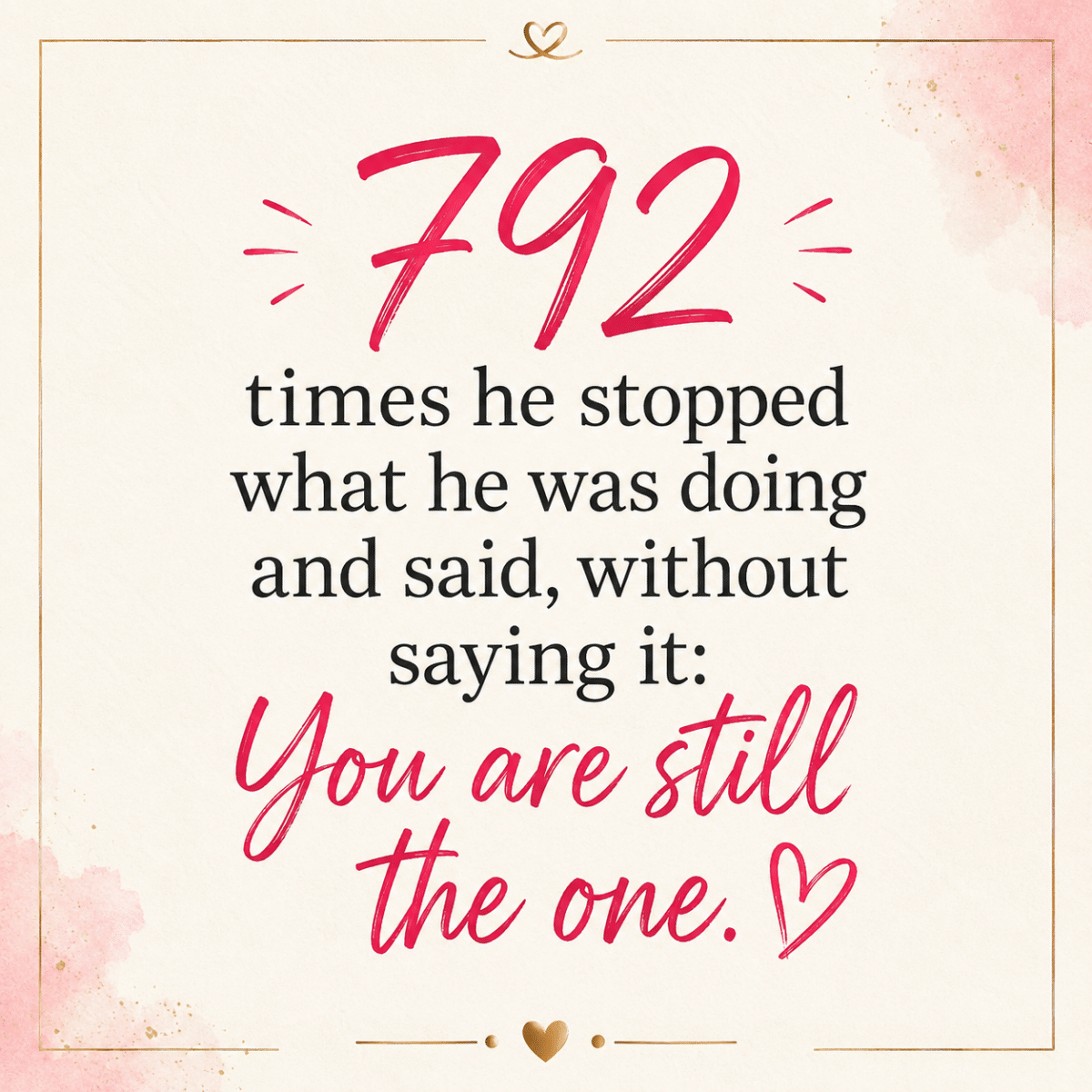
That’s roughly 792 times he stopped what he was doing and said, without saying it: You are still the one.
Seven hundred and ninety-two small moments. Almost none of them expensive or elaborate.
And all of them adding up to a woman who spent her entire adult life knowing — not guessing, not hoping — knowing she was cherished.
What Is a Monthly Anniversary Tradition?
A monthly anniversary tradition is a small, repeatable act of love you do on the same date every month — the date you got married.
If you were married on the 12th, the 12th of every month becomes your day. Married on the 3rd? The 3rd is yours. Married on the 30th? You’ve got 11 chances a year to celebrate.
The rules are gloriously simple:
Same date, every month. Predictable on purpose.
Small is the point. If it’s big, you’ll quit after a couple months.
Mix it up. The date repeats; the gesture doesn’t have to.
No scorekeeping. You’re not trading favors. You’re giving love freely.
Think of it as a standing appointment with your marriage — one your spouse never has to schedule, request, or hint about.
Why a Tiny Monthly Tradition Works Better Than a Grand Gesture
It’s tempting to think that a marriage this strong must have been built on something dramatic. A big romantic moment.
Nope. It was built on a Tuesday. And then another Tuesday. And then a Saturday. Over and over for 66 years.
And there’s real research behind why that works so well.
Garcia-Rada called them “powerful commitment devices” — which is a very academic way of saying: a tradition is a promise you keep making without having to say it out loud.
Small things often beats big things rarely.
After four decades of studying couples, Dr. John Gottman landed on a motto that fits Megan’s grandpa perfectly: small things often.
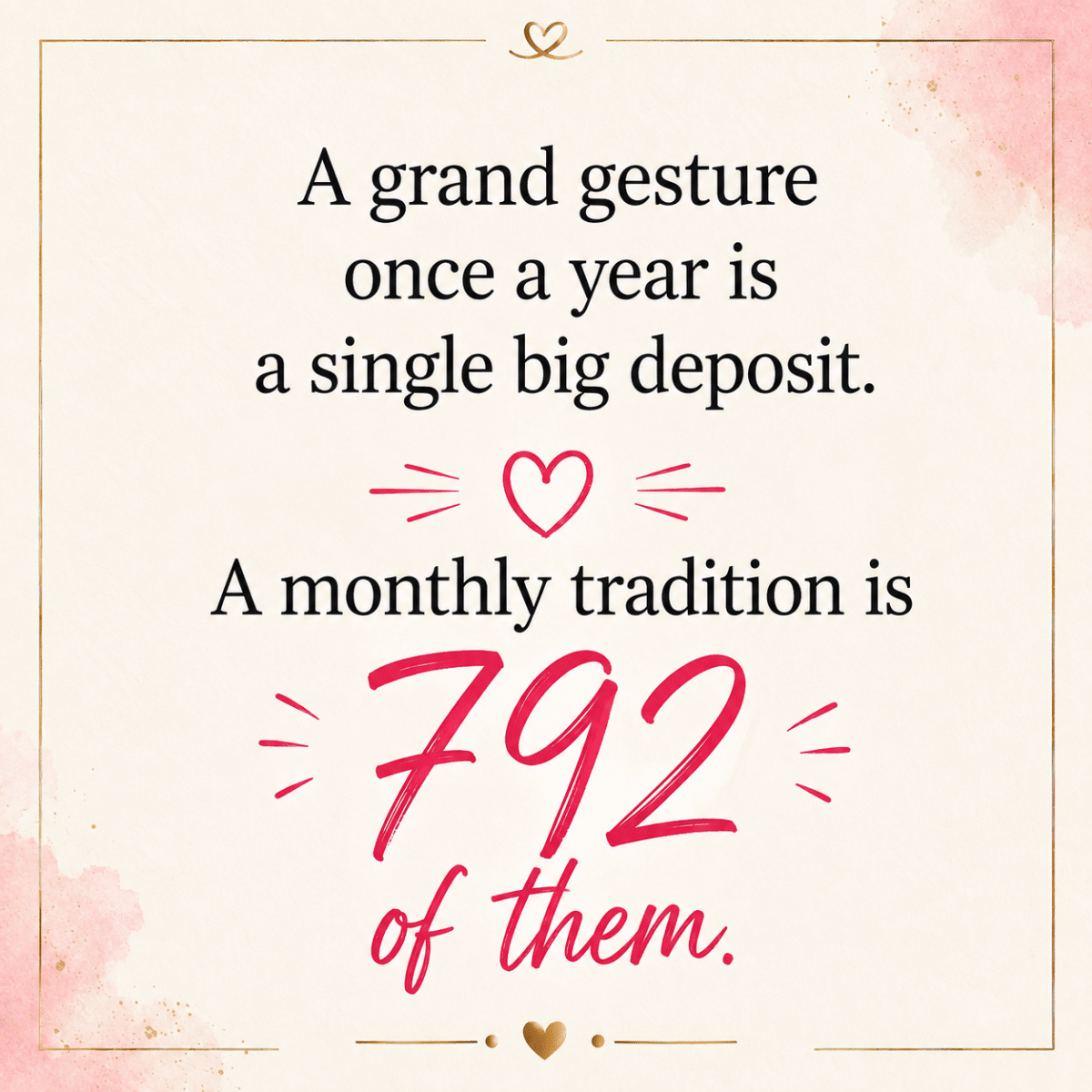
Gottman describes an “Emotional Bank Account” in every relationship. Every small moment of turning toward your spouse is a deposit. Every missed one is a withdrawal.
A grand gesture once a year is a single big deposit. A monthly tradition is 792 of them.
Guess which balance you’d rather have when life gets hard?
The anticipation is half the gift.
Here’s the sneaky bonus nobody tells you about traditions.
Once your spouse knows the 12th is your day, they start looking forward to it. On the 9th. On the 10th. On the 11th.
You’re not just giving them one good moment a month. You’re giving them something to look forward to twelve times a year, forever.
It survives the seasons when romance usually dies.
Newborn season. Busy work season. Grad school season. Caring-for-a-parent season. The seasons where a real date night feels impossible.
A monthly tradition bends. On a great month it’s a surprise candlelit dinner. On a brutal month it’s a sticky note on the bathroom mirror at 11:58 p.m.
Both count. That’s the beauty of it.
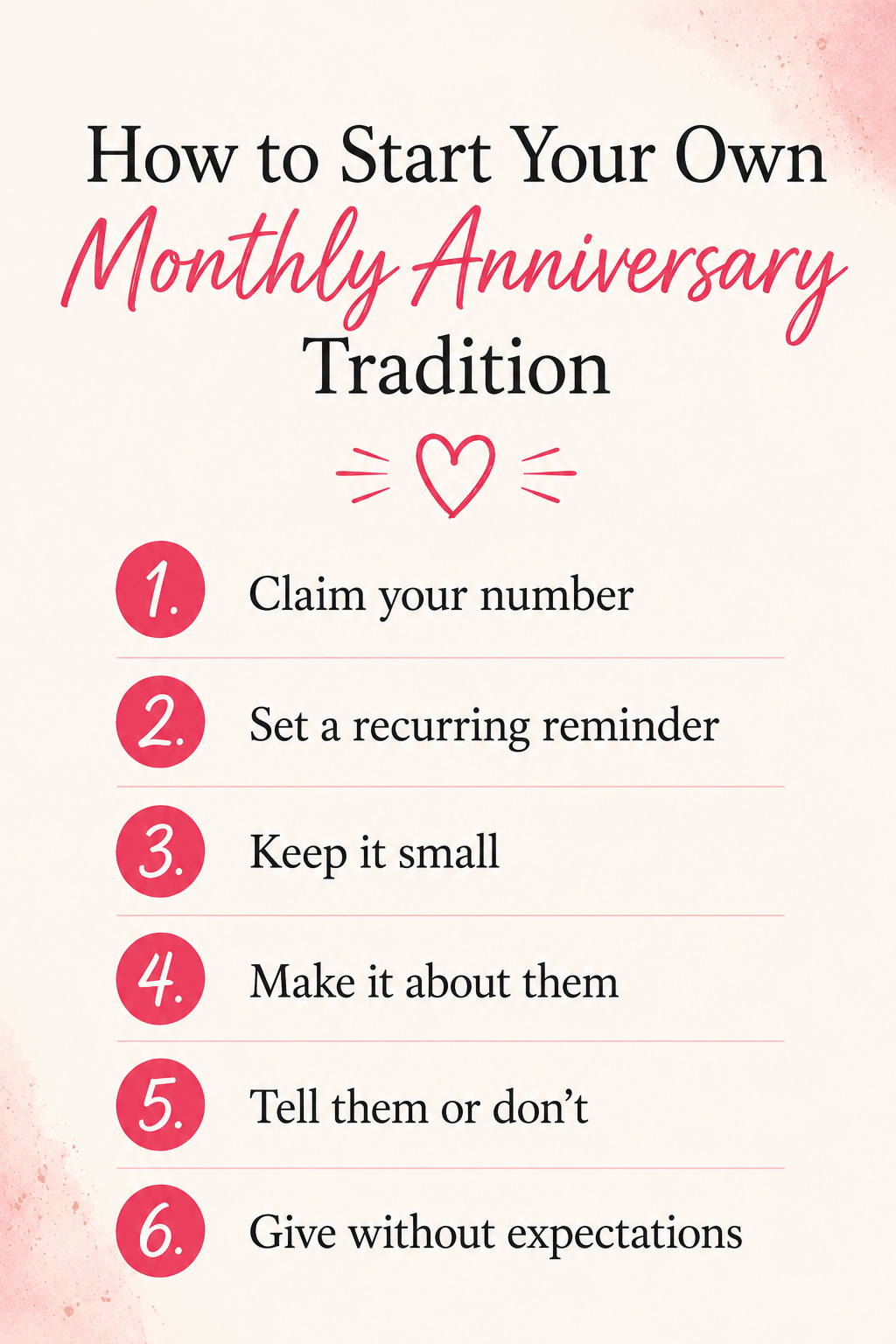
How to Start Your Own Monthly Anniversary Tradition
Ready? This takes about four minutes to set up and then it runs for the rest of your life.
1. Claim your number.
What’s your wedding date? Whatever day of the month you got married on — that’s your number.
Or switch it up and pick a different date. Use the day you met, your first date, or the day you got engaged. There’s no rule police here.
2. Set a recurring reminder RIGHT NOW.
Seriously. Stop reading. Open your phone. Create a repeating monthly reminder on your date and title it something that’ll make you smile when it pops up.
Megan’s grandpa did this with nothing but his own memory and a whole lot of devotion. You have a supercomputer in your pocket. You have no excuse. 😉
Pro Tip: Set it for two days before your date, so you have time to grab flowers or write a heartfelt love letter.
3. Keep it small enough to survive a bad month.
This is where most people struggle. They start strong in January with a candlelit dinner and a spa gift card, and by April they’ve quietly given up because they set the bar at Olympic height.
Set your baseline at “a note in their bag.” Anything above that is a bonus.
A tradition you actually keep for 30 years beats a spectacular one you keep for 4 months. Every time.
4. Make it about THEM, not about you.
The best monthly gestures aren’t the ones you think are romantic. They’re the ones your spouse feels.
If your husband’s love language is acts of service, a poem is nice — but handling the thing he’s been dreading all week? That’s the whole ballgame. If your wife lights up over words, a hand-written note will beat a gift card every single time.
So if a monthly date doesn’t fit your life, steal one of these instead — the Gottman Institute points out that rituals of connection build shared meaning, and shared meaning is what turns two people into a we.
The six-second kiss. Every hello and goodbye. Long enough to actually mean it.
Sunday night state of the union. Fifteen minutes, no phones: How was your week? What do you need from me this week?
The last ten minutes. Phones down, lights off, ten minutes of talking before sleep. Every night.
First-of-the-month adventure. One new-to-both-of-you thing every month. New restaurant, new trail, new anything.
The annual letter. Every anniversary, write each other a letter and don’t open last year’s until you’ve written this year’s.
The gratitude round. At dinner, each of you names one thing your spouse did that day. Kids can play too.
Here’s the thing nobody said out loud at that funeral, but is the KEY to the whole thing…
Grandpa didn’t wait.
He didn’t wait for her to be more affectionate first. He didn’t wait until finances were better, or the kids were older, or he had more free time, or he felt more appreciated.
He just… started. On the 12th. And then he kept going.
So much of the disappointment in marriage comes from waiting for our spouse to become the person who makes us feel loved.
But you don’t control their choices. You control yours.
You can’t make your spouse start a tradition. You can’t make them remember, or notice, or reciprocate on your timeline.
But you can be the one who goes first.
And here’s what tends to happen when you do: love that gets given consistently has a funny way of coming back around. Not always right away. But warmth is contagious, and a spouse who feels genuinely cherished usually starts cherishing back.
And even if it takes a while? You will have spent those months becoming the kind of person who loves well. That’s never a loss.
Megan’s grandparents got to live that bliss. And they got there twelve small moments a year at a time.
What Will They Say About Your Marriage?
Megan’s grandpa never knew that this would be the story told about him.
He wasn’t building a legacy. He was just buying flowers on a Thursday because it happened to be the 12th.
But 66 years of Thursdays turned into the thing his family will repeat for generations — and into a grandma who never once had to wonder whether she was adored.
You don’t need a bigger budget. You don’t need more free time. You don’t need your spouse to go first.
You just need a date on the calendar and the willingness to keep showing up.
What is a monthiversary?
A monthiversary is a monthly anniversary tradition is a small act of love you repeat on the same date every month — usually the day of the month you got married. If you were married on the 12th, you do something a little extra for your spouse on the 12th of every month. It can be flowers, a love note, a favorite treat, taking over a chore, or a five-minute mini date. The gesture changes; the date never does. Couples love it because it’s small enough to keep forever and consistent enough to build decades of connection.
How do you start a marriage tradition?
Start by picking a date that already means something — your wedding date, the day you met, or your engagement date. Set a recurring monthly reminder in your phone so you never have to rely on memory. Then choose a baseline gesture that’s small enough to do on your busiest month, like leaving a note on the bathroom mirror. Anything bigger is a bonus. The most common reason marriage traditions fail isn’t lack of love; it’s setting the bar too high to sustain.
Do small gestures really matter in a marriage?
Yes — and research backs it up. Dr. John Gottman’s decades of couples research produced a simple motto: small things often. Frequent small moments of connection build a stronger relationship than occasional grand gestures. Separately, researchers at Harvard found that couples who deliberately keep relationship rituals report greater satisfaction and commitment than couples who don’t. Consistency, not expense, is what makes a spouse feel genuinely cherished.
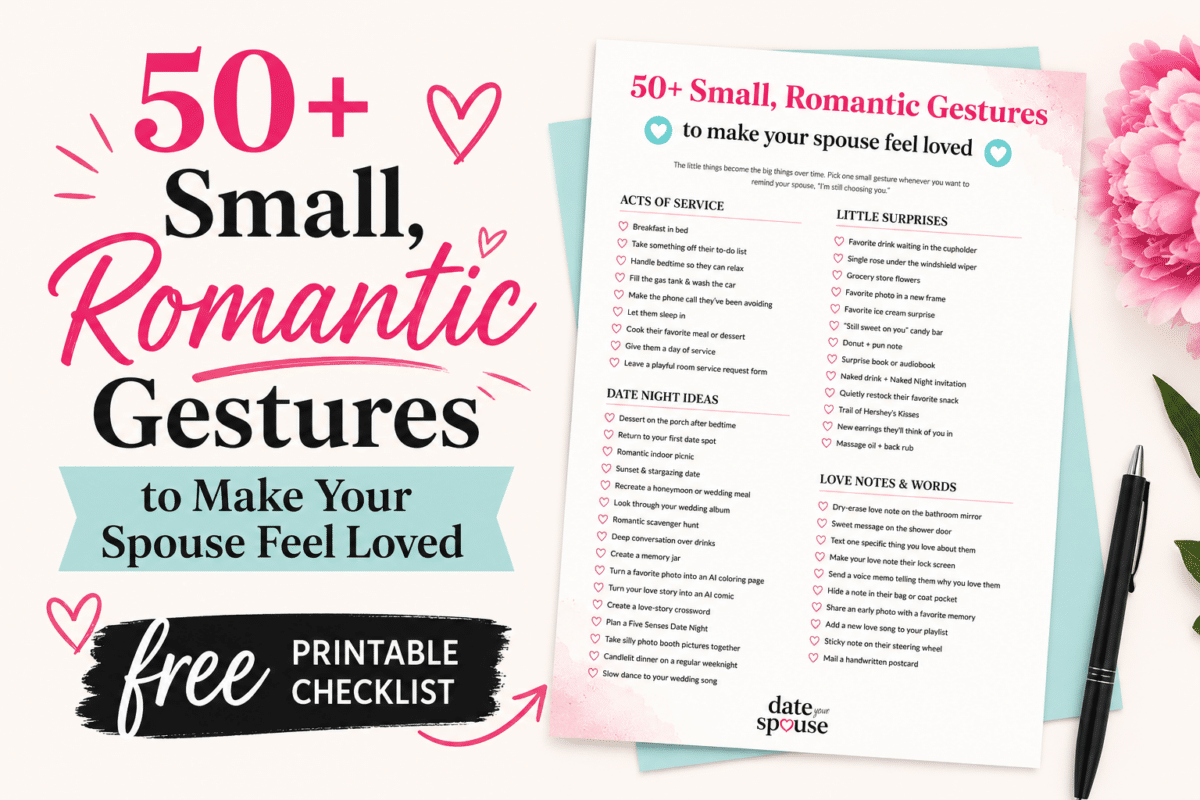
What are some simple ways to make your spouse feel loved?
Some of the easiest and most effective options take five minutes or less: a sticky note on the bathroom mirror, a voice memo instead of a text, their favorite drink waiting in the car, taking over the chore they dread most, a 20-second hug, or sending a photo from your first year together. The key is choosing gestures that match your spouse’s love language rather than the ones you personally find romantic.
What if my spouse never does anything romantic for me?
You can’t control your spouse’s choices, but you fully control your own — and someone has to go first. Starting a tradition without waiting for it to be reciprocated isn’t losing; it’s leading. Love that’s given consistently tends to come back around over time, because a spouse who feels genuinely cherished usually starts cherishing back. And even if it takes a while, you’ll have spent those months becoming a person who loves well, which is never wasted.
Is it strange to celebrate your anniversary every month?
Not at all — and it isn’t just for newlyweds. Celebrating a monthly anniversary simply gives you twelve built-in reminders a year to prioritize your marriage instead of one. You don’t have to call it an anniversary or make a fuss about it. Many couples quietly mark the date with a small gesture and never announce it. One couple kept the tradition for 66 years, and their family didn’t learn about it until the grandkids were grown.
More Marriage Resources
Reader Favorites
Our most-loved bedroom games & date-night ideas for couples:
Situationships tend to fall apart before fall because summer’s easy, low-pressure vibe runs out right when real routines return. Without a clear label or commitment, there’s nothing solid holding the connection together once school, work, and colder weather bring “real life” back, so the relationship quietly fades instead of turning into something more.
Two people walk in the same direction while remaining emotionally distant, illustrating how undefined relationships often rely on momentum rather than commitment.
If you’ve felt a summer connection start to cool off in August or September, you’re not imagining it. This pattern is common enough that it has a name among dating psychologists: the seasonal fade.
What Is a Situationship, Exactly?
A situationship is a relationship that sits somewhere between “just talking” and an official couple. You’re emotionally and physically involved, but neither person has defined what it actually is (Verywell Mind on situationships).
Common situationship traits:
You spend regular time together, but avoid the “what are we?” conversation
There’s real chemistry, but no clear future plans
One or both people benefit from the ambiguity, it feels lower-risk than a defined relationship
That ambiguity feels fun in summer. It feels a lot less fun once fall routines start and one person quietly wants more.
Why Situationships Tend to End Before Fall
1. The Calendar Effect: Routines Return
Summer schedules are loose. People have more free evenings, more spontaneous plans, and more energy for something casual. Once September hits, school starts, work ramps back up, days get shorter… that free time disappears fast.
A situationship survives on convenience. When the convenience goes, so does the motivation to keep showing up without a real commitment behind it.
2. No Labels Means No Foundation
Undefined relationships run on momentum, not structure. Psychologists describe commitment as one of the key factors that helps relationships survive stress and distance. Without it, a normal life change, a new semester, a busier work season, is often enough to end things, because there was never an agreement to work through it together.
A situationship doesn’t fall apart because the timing was bad. It falls apart because there was nothing built to withstand a change in timing.
3. Fear of Commitment Meets Reality
Situationships often attract at least one person with an avoidant attachment style – someone who’s comfortable with closeness as long as it doesn’t require a real label (Psychology Today on attachment). Summer’s casual pace makes that avoidance easy to hide. But as the other person naturally starts wanting more clarity heading into fall, the avoidant partner tends to pull back instead of stepping up.
4. Novelty Wears Off
A lot of what makes a summer connection feel intense is novelty – new person, new activities, warm weather, fewer responsibilities. Novelty and excitement can create feelings that mimic real emotional closeness, even when the connection hasn’t actually deepened. Once the season’s excitement fades, some situationships fade with it, because the spark was doing more work than the actual connection was.
The Psychology Behind the Summer-to-Fall Drop-Off
Here’s the short version of why this pattern repeats every year:
Less structure = lower stakes. Summer makes casual connection feel consequence-free.
Ambiguity is comfortable until it isn’t. It protects both people from rejection, but it also prevents real closeness.
External change reveals internal doubt. A new season forces a decision that the relationship was never built to make.
None of this means situationships are “bad.” They can be a genuinely fun, low-pressure way to date. The issue is expecting a connection with no foundation to survive a season change without one honest conversation.
Signs Your Situationship Might Not Survive the Season
You can usually tell early if a situationship is heading toward a fade-out:
Plans get vaguer (“we should hang out soon” instead of actual dates)
Communication drops as schedules get busier
One person avoids any conversation about the future
You feel more like a “summer plan” than a person they’re building something with
If two or more of these sound familiar, it’s worth having a direct conversation before fall — not after you’ve already noticed the distance.
What To Do If You Want More Than a Situationship
If you actually like this person and want to see if it can go somewhere real, here’s what tends to work:
Ask directly, early. Not “what are we,” but something simpler: “I’ve liked this, do you see this going anywhere past summer?” Direct questions get more honest answers than hints.
Watch actions, not just words. Someone who wants a future with you will make plans that extend past the season, not just this weekend.
Don’t over-invest in ambiguity. If someone has avoided every real conversation for weeks, that avoidance is information, not a problem you can fix by waiting longer.
Be willing to let it end. A situationship ending in fall isn’t a failure — it’s just proof the connection needed more structure than either person was ready to give it.
This applies the same way regardless of gender or relationship style — the pattern is about commitment and clarity, not who’s involved.
Summary
Situationships often end before fall because they run on convenience and novelty, not commitment.
Once summer’s free time and easy pace disappear, there’s usually nothing solid left to hold the connection together.
Avoidant attachment and undefined expectations make the “what are we” conversation easy to avoid all summer — until real life forces the question.
If you want something real, ask directly and pay attention to actions, not just chemistry.
If you’re ready to date with more clarity instead of guessing where things stand, Mingle2.com is a straightforward place to meet people who are upfront about what they’re looking for.
Can you turn a situationship into a relationship? Sometimes. Follow these five steps to learn how.
If you’ve been dating someone for a while but you haven’t yet defined the relationship, you’re probably in a situationship. Maybe you see each other every week. Maybe you’ve met a few of their friends. But if you want to be exclusive and haven’t discussed it yet, you might be feeling anxious or insecure about where you stand.
Here’s the good news. Situationships can absolutely turn into committed relationships. It happens more often than you’d think, and it’s not because someone gave an ultimatum. It happens because one person shifted the dynamic in a way that made commitment feel like the natural next step rather than a demand.
Here are five surprising ways to make that shift from situationship to relationship.
1. Be direct about how you feel
It’s tempting to read into every text and every conversation, building a case in your mind for where things are headed. Instead, be direct about how you feel about him. Many women wait for a man to initiate the DTR (define the relationship) conversation. I encourage you to assert yourself in a non-threatening, undemanding way. A simple, “I’m really enjoying getting to know you, and I’d like to stop dating others to see where this goes. How do you feel about that?” You’ll learn a lot more from his answer than from any amount of guessing.
2. Show him your value and standards instead of convincing him of it
Many women try to talk a potential partner into commitment, listing reasons why the relationship should move forward. This rarely works. What does work is living as a woman of value: having your own full life, your own friendships, your own values and standards, and bringing that fullness into the relationship. When a man experiences your value firsthand and he sees that you have standards without being pushy, the right man will want to become your boyfriend.
3. Slow down the physical intimacy
Physical intimacy can create a false sense of emotional closeness, especially early on. If a situationship becomes physical too soon, it’s easy to become attached and live with the false hope that it’s only a matter of time before he chooses to be in a relationship with you. I recommend keeping the physical contact to a minimum before exclusivity. This can create space for the emotional intimacy and actual connection to develop. It helps you spot red flags early on and be clear about your feelings instead of giving him all the power to decide whether he wants to be with you exclusively.
4. Name what you’re experiencing, calmly and without pressure
A gentle check-in works far better than an ultimatum. Try something like, “We’ve been spending a lot of time together, and I’d love to understand where you see this going.” This kind of statement invites conversation rather than triggering defensiveness. It gives him room to step up rather than backing him into a corner.
5. Get comfortable walking away if the answer is no
If he is not interested in moving towards a relationship, but you are, walk away with your dignity intact. The willingness to walk away, truly walk away, is often what shifts a situationship most powerfully. Not as a manipulation tactic, but as a boundary rooted in self-respect. When you know your worth and you’re willing to honor it, you either get the relationship you deserve, or you free yourself up to find someone who’s ready and willing to give it to you.
A situationship doesn’t have to stay stuck. With clarity, self-respect, and the willingness to have honest conversations, it can absolutely become the relationship you’ve been hoping for. And if it doesn’t, you’ll be that much closer to finding someone who’s ready to meet you there.
And remember…it’s never too late to go on your last first date.
If you’re feeling stuck in dating and relationships and would like to finally find love, apply for a complimentary 30-minute love breakthrough session with Sandy https://lastfirstdate.com/application