Blog

  • Dating Coach Melbourne Guide

    Dating Coach Melbourne Guide

    Dating Coach Melbourne – Why Melbourne Singles Keep Getting Stuck


    Melbourne is supposed to be different from Sydney. Less frantic, more cultured, better coffee, a social scene built around neighbourhood life rather than beach status. And in many ways it is different. But if you are trying to date here, you will have noticed that different does not necessarily mean easier.

    The city that prides itself on its creative energy, its laneway culture and its fiercely local sense of identity has produced a dating scene that is, in its own particular way, just as frustrating as anywhere else. The apps are full. The options look good on paper. And yet something keeps not quite working – the connections that fizzle after two weeks, the promising first dates that produce no second ones, the situationships that stretch across entire seasons without ever becoming anything defined.

    If any of that is familiar, the problem is almost certainly not you. It is more likely something specific about how you are navigating a dating environment that has its own distinct dynamics – and knowing what those dynamics are is where a dating coach Melbourne singles can genuinely rely on becomes useful.


    KEY TAKEAWAYS

    • The honest answer is that Melbourne’s dating difficulties are not random – the city’s neighbourhood-based social culture, its creative professional density and its particular brand of emotional intelligence create specific patterns that repeat until something deliberate changes them.

    • Working with an experienced dating coach who understands competitive urban dating markets produces faster, more targeted results than either general self-improvement or more time on the apps.

    • Before your next date or conversation, identify honestly which stage of the process keeps breaking down for you – meeting people, making an impression, progressing, or choosing wisely – because each one has a completely different solution.

    • This is for any Melbourne single who is putting in genuine effort and not seeing results, and who wants a specific, honest diagnosis rather than another article telling them to love themselves first.


    What makes Melbourne’s dating scene specifically difficult


    Every major city produces its own dating culture, and Melbourne’s is shaped by things that are genuinely distinctive about the city itself.

    The neighbourhood effect is the most significant. Melbourne is not one city in the way Sydney is – it is a collection of strongly defined communities that happen to share a postcode. Fitzroy has its own creative ecosystem. Collingwood has its own social world. South Yarra operates on a completely different frequency from Brunswick. St Kilda has its own particular relationship with weekend energy. This is part of what makes Melbourne feel so liveable. It is also part of what makes its dating pool feel smaller than a city of five million people should produce, because most people are meeting within their existing network rather than across it.

    The second dynamic is what might be called Melbourne’s intelligence threshold. This is a city that values depth, cultural literacy and a certain kind of conversational sophistication. That sounds like good news for dating, and in some ways it is – shallow interactions are less tolerated here than in some other cities. But it also produces a dating culture where people can be very good at the intellectual performance of connection while remaining quite guarded about actual emotional availability. The first date conversation in Carlton can be genuinely brilliant. The follow-through can be considerably less so.

    The third is the lifestyle fragmentation. Melbourne’s professional and creative communities work hard and socialise within clearly defined social worlds. The organic meeting of genuinely different people – the kind that produces the most interesting connections – happens less often than the city’s size would suggest. The apps theoretically solve this, but in practice they tend to surface the same demographic pool in a slightly different order.


    What a genuinely useful dating coach Melbourne actually does


    The phrase dating coach Melbourne covers a significant range, from people who offer advice on the basis of their own dating experience to coaches with genuine track records built over years of client work. The difference matters more than most people realise.

    What over two decades of coaching actually produces is not a larger collection of techniques. It is a specific quality of diagnostic speed – the ability to identify quickly, in the first session, exactly which stage of the process is causing the problem and why. After enough of those conversations, you stop being surprised by patterns. You start seeing them early and knowing from experience what actually changes them.

    James has spent 21+ years working with singles across the UK, Australia and beyond – across every demographic, relationship history and version of the same core frustrations. The perspective that produces is genuinely different from someone who has been coaching for a few years, however talented. It is the difference between knowing what the research says and knowing what actually happens in practice, repeatedly, across thousands of real situations.

    For Melbourne singles who are also thinking about whether a more structured approach to meeting people might suit them – through an introduction agency or matchmaking service rather than apps – understanding what reputable dating services currently offer and how to evaluate them is worth doing before making any decisions. The Australian market has grown considerably in recent years and the quality varies widely.


    The patterns that come up most in Melbourne coaching sessions


    Dating coach Melbourne sessions consistently surface a handful of patterns that are worth naming because recognising yourself in one of them is the fastest route to addressing it.

    The creative professional pattern is the most common. Melbourne attracts people who are thoughtful, self-aware and genuinely interesting – and who have often developed a level of self-sufficiency that makes genuine vulnerability in early dating feel uncomfortable. The result is connections that have real energy but stay at a certain emotional altitude for too long, until one person loses interest or the whole thing dissolves into friendship without either party quite understanding how.

    The overthinking pattern follows closely behind. Melbourne’s intellectual culture produces daters who analyse every interaction with considerable sophistication – which is useful up to a point and actively unhelpful beyond it. The person who has correctly identified three possible interpretations of a text message is not better placed to respond to it. They are worse placed, because the analysis has replaced the instinct.

    The third is the progression avoidance that comes from a city that values keeping things easy. Melbourne’s social culture is warm but non-confrontational. The direct conversation about what two people actually want from each other – the one that would resolve weeks of uncertainty in a single exchange – keeps not happening because neither person wants to be the one who makes things awkward.

    All of these patterns are addressable. All of them are considerably clearer when you are working with someone who has seen them enough times to name them in the first session.


    How the Dating Coach Melbourne coaching works


    All sessions with James run via Zoom, which means the coaching is fully accessible to Melbourne singles regardless of which part of the city you are in or how demanding your schedule is. There is no commute, no finding a time that works around location, and no compromise on the quality or depth of the session itself.

    A first session covers your current situation in genuine detail – what you have tried, what the pattern of results has looked like, and where specifically things keep breaking down. The questions James asks tend to surface the relevant issue quickly, because 21+ years of having this conversation means the diagnostic process moves fast.

    For anyone who has been wondering whether a dating coach might genuinely change their results rather than simply validate their frustration, the coaching process is the right place to start. Some clients need one session to get what they need. Others work with James across several as they move through different stages – from initial approach through to how to handle the progression from something casual to something defined.

    Melbourne is a genuinely brilliant city to find a relationship in. The people are interesting, the environment is conducive to connection, and the social culture values depth over performance. What most singles are missing is not opportunity. It is the specific, personalised support that turns opportunity into something real.


    Take the shortcut.


    You could keep figuring this out on your own. Or you could work with a dating coach who has seen it all before. James has over two decades of those conversations behind him.


    /


    .

    Source link

  • Modern Women Are FINALLY Realizing How Dating Has Changed

    Modern Women Are FINALLY Realizing How Dating Has Changed


    moderndating #relationships #datingculture #menandwomen Modern Women Are FINALLY Seeing The Damage They Did To …

    source

  • Interest Vs. Attraction Vs. Chemistry: What’s The Difference?

    Interest Vs. Attraction Vs. Chemistry: What’s The Difference?

    We are a professional review company that receives compensation from companies whose products we review. We test each product thoroughly and give high marks only to the ones that are the very best. We are independently owned, and the opinions expressed here are our own.

    The date seemed to go well.

    She laughed. She asked questions. The conversation flowed. Maybe she stayed longer than you expected. Maybe she even kissed you before you went home.

    Then, a day or two later, you hear something confusing:

    “I had a great time, but I didn’t feel the chemistry.”

    Wait.

    If she enjoyed the date, wasn’t she interested?

    And if she kissed you, wasn’t she attracted to you?

    So what exactly was missing?

    This is one of the more confusing parts of dating because people often use words like interest, attraction, chemistry, spark, and connection as though they all describe the same thing.

    They don’t necessarily.

    A woman can enjoy spending time with you without wanting a relationship.

    She can find you physically attractive without feeling that something deeper is developing.

    And two people can experience strong chemistry while being completely wrong for each other in the long run.

    Understanding these differences can help explain one of the most frustrating dating experiences:

    Everything seemed to be going well – and yet the connection still didn’t develop.

    What Does Interest Mean in Dating?

    Interest is probably the broadest of the three.

    If a woman is interested in you, she wants to know more about you.

    She may ask questions, enjoy talking to you, respond enthusiastically to your messages, accept another date, or seem curious about you.

    That’s good.

    But interest doesn’t automatically mean romantic attraction.

    Think about how many people you’ve enjoyed talking to without wanting to date them.

    You can find someone funny, intelligent, interesting, or fascinating without imagining kissing them.

    Dating interest can also be exploratory.

    She may genuinely not know how she feels about you yet.

    That’s part of what dates are for.

    She’s spending time with you because she’s interested enough to discover whether something more develops.

    And you’re doing the same thing with her.

    Interest opens the door. It doesn’t tell you what will happen after you walk through it.

    What Does Attraction Mean?

    Attraction adds another dimension.

    Instead of simply thinking:

    “I enjoy talking to him.”

    There is some degree of:

    “I’m drawn to him.”

    That can include physical attraction, but attraction isn’t determined entirely by physical appearance.

    How you speak, move, smell, flirt, listen, carry yourself, respond to her, and make her feel when you’re together can all influence attraction.

    And importantly, attraction can change.

    Someone can look fantastic in a dating profile but become less attractive once you meet them.

    Someone else might not immediately be your usual “type,” but become increasingly attractive as you get to know them.

    That’s one reason reducing attraction to a checklist of physical features misses so much of what happens between two people.

    But attraction alone doesn’t guarantee dating will progress.

    A woman can find you attractive and still decide that she doesn’t want another date.

    Which brings us to the word that causes perhaps the most confusion.

    What Does Chemistry Mean in Dating?

    Chemistry is harder to define because people don’t always mean the same thing when they use the word.

    Some people mean sexual tension.

    Others mean emotional connection.

    Some describe chemistry as effortless conversation, playful flirting, feeling unusually comfortable together, or simply experiencing a difficult-to-explain “spark.”

    That’s why hearing:

    “There wasn’t enough chemistry.”

    can be frustrating.

    What exactly does that mean?

    A practical way of thinking about chemistry is that it describes what seems to happen between two people when they interact.

    Attraction can exist primarily in your experience of another person.

    Chemistry involves the dynamic created between you.

    Maybe conversation becomes playful without either person forcing it.

    Eye contact lingers slightly longer.

    You naturally move closer.

    Silence doesn’t feel uncomfortable.

    You make each other laugh.

    You’re curious about what might happen next.

    But chemistry is not a mathematical formula.

    Two people can experience the same date differently.

    And that’s where things get complicated.

    Can She Be Interested in You Without Being Attracted to You?

    Absolutely.

    She might genuinely enjoy your company.

    She may think you’re funny, intelligent, kind, or interesting.

    She might happily spend two hours talking to you.

    But she may still not feel romantic interest.

    This is one reason a date seeming to go well isn’t always enough to predict whether there will be another one.

    From your perspective, you might think:

    “We talked for three hours. She was laughing. We had so much in common. That was a great date.”

    She might agree with every word of that description.

    And still think:

    “I liked him, but I didn’t feel attracted to him.”

    Neither person necessarily misunderstood what happened.

    You experienced different parts of the interaction differently.

    Can She Be Attracted to You but Feel No Chemistry?

    Yes.

    Imagine seeing someone across a room and immediately finding her attractive.

    Attraction already exists before you’ve exchanged a single word.

    Then you start talking.

    And… nothing happens.

    Conversation feels forced.

    Your humor doesn’t connect.

    Your personalities clash.

    Neither of you seems particularly curious about the other.

    The physical attraction may still be there, but the interaction itself doesn’t create much excitement.

    Dating apps make this especially easy to experience.

    A profile can create attraction.

    Meeting determines what happens when two actual human beings enter the same room.

    That’s why:

    “I find you attractive”

    and

    “I feel chemistry with you”

    aren’t necessarily identical statements.

    Can You Have Chemistry Without Being Compatible?

    This distinction may be even more important.

    Because chemistry can feel incredible.

    You can’t stop talking.

    The flirting is effortless.

    You want to touch each other.

    You think about her when you’re apart.

    Everything feels intense.

    And yet your lives may be completely incompatible.

    You want children. She doesn’t.

    You want commitment. She wants something casual.

    Your values conflict.

    Your lifestyles don’t fit.

    Neither of you handles conflict particularly well.

    Chemistry tells you something about how the connection feels.

    Compatibility tells you something about whether two lives can actually work together.

    Ideally, a healthy long-term relationship contains both.

    But chemistry alone can’t guarantee one.

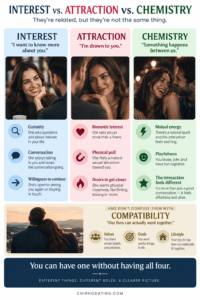
    comparison infographic between interest and attraction and chemistry,comparison infographic between interest and attraction and chemistry,

    Why Would She Kiss You If She Didn’t Feel Chemistry?

    This question can be especially confusing.

    If she kissed you, surely that proves she was attracted to you?

    It can indicate attraction.

    But people aren’t laboratory instruments that produce perfectly consistent signals.

    She may have wanted to see how the kiss felt.

    She may have been attracted to you in that moment.

    She may have enjoyed the date but realized afterward that she didn’t want to continue.

    Or she may have interpreted the experience differently than you did.

    A kiss is information.

    It isn’t a contract for another date.

    This is why trying to decode one individual moment can drive you crazy.

    What happens afterward often tells you much more.

    Can Attraction and Chemistry Grow Over Time?

    Sometimes.

    Not every strong relationship begins with fireworks.

    People can become more attractive as you discover their personality, confidence, humor, warmth, intelligence, or character.

    Chemistry can also develop as two people become more comfortable around each other.

    But that doesn’t mean attraction can always be manufactured just by trying hard enough.

    If someone tells you she doesn’t feel the connection she’s looking for, arguing with her perception rarely creates it.

    You don’t need to prove that the date objectively went well.

    You don’t need to present evidence.

    And you don’t need to convince her to feel differently.

    Attraction isn’t a debate you can win.

    Why Can a Date Feel Great to You but Not to Her?

    I’ve experienced this myself.

    I’ve been on dates where, from my perspective, everything seemed to be working.

    The conversation felt good. Nothing obviously went wrong. I came away thinking the date had gone well.

    She experienced it differently.

    That can be hard to understand because we naturally evaluate an interaction through our own experience.

    If I felt comfortable, perhaps she did too.

    If I felt chemistry, surely she noticed it.

    If I thought the conversation flowed, how could she think something was missing?

    But two people can have the same date while experiencing it differently.

    You have access to your thoughts, emotions, expectations, and attraction.

    You don’t have direct access to hers.

    That’s why a date can genuinely feel successful to you while leaving her uncertain.

    It doesn’t necessarily mean you missed some enormous mistake.

    Sometimes two people don’t experience the connection in the same way.

    Chemistry Isn’t Mind-Reading

    Another problem occasionally shows up in dating.

    Some people expect a potential partner to intuit what they want without clear communication.

    A look is supposed to tell you what to do.

    A subtle change in tone is supposed to reveal what she’s feeling.

    You’re expected to “just know.”

    And when you’ve only recently started dating someone, that’s an unrealistic standard.

    You haven’t spent years learning each other’s expressions, habits, moods, and communication patterns.

    You barely know each other.

    Being attentive is useful.

    Learning to read body language is useful.

    Paying attention when someone seems uncomfortable is important.

    But chemistry isn’t telepathy.

    A healthy connection should gradually make communication easier, not require you to pass a secret test where you’re expected to interpret every glance correctly.

    If someone wants something from you, communication eventually matters.

    You can become better at noticing signals.

    You cannot become responsible for reading another person’s mind.

    Why Do Women Sometimes Lose Interest After Dates That Seemed to Go Well?

    Because a good date and growing romantic attraction aren’t necessarily the same thing.

    Maybe she enjoyed herself but didn’t feel enough attraction.

    Maybe there was attraction but little chemistry.

    Maybe both existed, but she noticed an incompatibility.

    Maybe she met someone else.

    Maybe something changed in her life.

    Or maybe her interest didn’t develop further.

    That’s why I’ve written separately about why women lose interest after a few dates.

    The important thing is not to conclude automatically:

    “I must have ruined everything.”

    Sometimes there is something useful to learn from what happened.

    Other times, the connection didn’t progress.

    Dating involves discovering both possibilities.

    Stop Trying to Decode One Signal

    This is where many men make dating much harder than it needs to be.

    They focus intensely on individual signals.

    “She used a heart emoji.”

    “She touched my arm.”

    “She kissed me.”

    “She replied in five minutes.”

    “She said she had fun.”

    Any of those things can be encouraging.

    None of them tells you everything.

    Instead, watch the pattern.

    Does she continue talking to you?

    Does she initiate sometimes?

    Does she seem engaged when you communicate?

    Does she accept another date?

    Does she help make that date happen?

    Does her investment increase as you get to know each other?

    Those patterns are usually more informative than trying to interpret one glance, text, kiss, or emoji.

    And if she suddenly stops responding altogether, that’s a different problem from trying to interpret one isolated signal.

    I’ve broken down some of the most common reasons in Why Did She Stop Texting Me?

    The reverse can happen too. A woman may keep talking to you without actually moving the connection toward a date. If that’s happening, here’s why she may keep texting but not want to meet up.

    What If Her Behavior Starts Changing?

    This is where the distinction becomes particularly useful.

    Suppose she initially seemed interested.

    She replied quickly.

    She asked questions.

    She agreed to dates.

    She sometimes initiated conversations herself.

    Then something changes.

    Her messages become shorter.

    She takes longer to reply.

    She stops initiating.

    Making plans becomes difficult.

    Now you’re no longer trying to answer an abstract question about chemistry.

    You’re observing a behavior change.

    That doesn’t automatically tell you why it changed.

    But it gives you something concrete to focus on.

    If you’re experiencing that now, understanding why she’s texting you less can help you see the pattern without panicking over every message.

    And if you respond to her pulling away by dramatically increasing how often you contact her, you can create another problem.

    At that point, it may be worth asking:

    Am I texting her too much?

    Interest vs. Attraction vs. Chemistry: The Difference

    The easiest way to remember the difference is this:

    Interest:
    “I want to know more about you.”

    Attraction:
    “I’m drawn to you romantically or physically.”

    Chemistry:
    “Something happens between us when we’re together.”

    And I’d add a fourth:

    Compatibility:
    “Our lives, values, needs, and relationship goals can actually work together.”

    You don’t need to classify every interaction into one of these categories obsessively.

    Dating isn’t an exam.

    The point is to understand why:

    “But the date went well!”

    doesn’t always mean:

    “Therefore she must want another one.”

    And why:

    “She was attracted to me.”

    doesn’t necessarily mean:

    “Therefore we’re right for each other.”

    Final Thoughts: Pay Attention to What Develops

    You cannot control whether another person feels attraction or chemistry with you.

    And you shouldn’t have to perform perfectly to keep the right person interested.

    What you can do is become better at noticing what develops between you.

    Is curiosity growing?

    Is attraction becoming mutual?

    Does communication become easier?

    Are both of you investing?

    Do you actually enjoy who you become around each other?

    Those questions tell you much more than trying to decipher one mysterious glance across a restaurant table.

    The goal isn’t to become perfect at reading women.

    It’s to become better at recognizing reciprocity.

    Because when something healthy is developing, you shouldn’t be the only person trying to make it happen.

    Rickard

    Source link

  • 🎈Ep79: Don’t Pop It: Love Mountain Edition (A Balloon Dating Show)

    🎈Ep79: Don’t Pop It: Love Mountain Edition (A Balloon Dating Show)


    Welcome to Season 3 of “Don’t Pop It” (Love Mountain Edition) A Balloon Dating Show! In episode seventy-nine we have another …

    source

  • Why Owning Your Herpes Status Filters Out the Wrong Men

    Dating With Herpes can bring concerns about rejection, disclosure, and how potential partners will respond. However, owning your herpes status can also help you approach relationships with greater honesty and confidence. Instead of trying to hide a diagnosis, you can treat it as one part of your health story and have open conversations with people you are considering dating.

    Herpes is common worldwide. The World Health Organization estimates that hundreds of millions of people have HSV-2, while billions have HSV-1. Many infections cause no symptoms or symptoms that go unnoticed. Understanding this can help reduce unnecessary shame and make conversations about sexual health more comfortable.

    Being open about herpes does not mean everyone will accept it, and it should not. Every person has the right to make informed decisions about sexual health. At the same time, you have the right to expect honesty, privacy, respect, and kindness from anyone you date.

    What Does It Mean to Own Your Herpes Status?

    Owning your status means accepting that herpes is part of your health history without allowing it to determine your self-worth. It involves learning accurate information, following appropriate medical advice, and communicating honestly with potential partners before sexual activity.

    Herpes Dating Confidence does not mean never feeling nervous about disclosure. It means being prepared to have the conversation without treating yourself as less deserving of love or respect.

    Herpes Is a Health Condition, Not Your Identity

    A herpes diagnosis does not describe your personality, values, appearance, ambitions, or ability to maintain a relationship. It is a medical condition that can be managed and discussed responsibly.

    When you separate your diagnosis from your identity, disclosure can become less intimidating. You are sharing important health information with another person, not confessing to something that makes you unworthy.

    How Owning Your Status Filters Out the Wrong Men

    Being honest about herpes can naturally reveal how someone approaches communication, boundaries, and sexual health. A person’s response does not automatically make them right or wrong, but it can show whether your expectations and boundaries are compatible.

    Disrespect Is Useful Information

    If someone responds to disclosure with insults, humiliation, pressure, or cruel comments, you have learned something important about that interaction. You do not have to convince someone to respect you.

    Dating With Herpes should involve mutual consideration. If a person cannot discuss sexual health respectfully, continuing the relationship may not align with your boundaries.

    Honesty Creates a Natural Boundary

    Disclosure gives both people an opportunity to make an informed choice. Some people may be comfortable continuing after learning about herpes, while others may decide they are not.

    Although rejection can hurt, knowing someone’s position early can prevent misunderstandings later. You do not have to hide your status simply to keep someone’s interest.

    Why Self-Respect Matters When Dating With Herpes

    A herpes diagnosis can sometimes affect confidence, particularly after a recent diagnosis. Fear of rejection may lead someone to accept behavior they normally would not tolerate.

    Herpes Relationship Advice should therefore include more than information about transmission. It should also involve healthy boundaries and self-respect.

    You Still Deserve Standards

    Having herpes does not mean you should accept poor communication, dishonesty, manipulation, or disrespect. You can still expect a potential partner to communicate openly and treat your personal information responsibly.

    A healthy relationship requires consideration from both people. You have responsibilities around disclosure and sexual health, while your partner has responsibilities around respect and informed consent.

    You Do Not Need Universal Approval

    Dating naturally involves rejection and incompatibility for many different reasons. A person deciding that they are not comfortable with herpes does not determine your value.

    Herpes Status Acceptance can mean accepting that different people will make different choices while remaining confident in your own boundaries.

    How to Talk About Your Herpes Status

    Disclosure is usually easier when you have accurate information and know what you want to communicate. You can explain your diagnosis, answer reasonable questions, and discuss steps you take to reduce transmission risk.

    The CDC recommends informing current and future sex partners about genital herpes and discussing ways to reduce transmission.

    Choose a Comfortable Setting

    A private conversation can make it easier for both people to ask questions. Some people prefer discussing their status in person, while others may feel more comfortable talking privately through messages or a phone call.

    Your safety matters too. You are not required to disclose personal health information in a situation where you feel threatened or pressured.

    Give the Other Person Time

    Someone may have questions or may need time to learn about herpes. You can provide factual information without trying to pressure them into accepting the relationship.

    Herpes Disclosure works best when both people can communicate honestly and make their own decisions.

    Discussing Sexual Health Responsibly

    After disclosure, the conversation can include practical risk-reduction strategies. These may include avoiding sexual contact during outbreaks or symptoms, using condoms, and discussing suppressive antiviral medication with a healthcare professional.

    The CDC notes that condoms can reduce, but do not eliminate, the risk of genital herpes transmission.

    Understand Asymptomatic Transmission

    Herpes can sometimes be transmitted when visible symptoms are absent. This is one reason honest communication and appropriate precautions remain important.

    Dating With HSV requires realistic expectations rather than promises of zero risk. A healthcare professional can provide advice based on your specific diagnosis and circumstances.

    Avoid Making Promises About Risk

    No prevention method provides an absolute guarantee against herpes transmission. Instead of saying that transmission cannot happen, focus on the measures you can realistically take to reduce risk.

    Clear information helps both partners make informed decisions.

    What Healthy Acceptance Can Look Like

    A potential partner does not need to react perfectly immediately. They may have questions because they have limited knowledge about herpes.

    Someone who listens, asks respectful questions, and wants to understand the situation may be approaching the conversation thoughtfully.

    Look Beyond the Initial Reaction

    People sometimes react based on misconceptions. Providing reliable health information may help them understand the condition better. However, education should never become pressure.

    Confident Herpes Dating means allowing another person to make their own informed choice while maintaining your own standards.

    Keep Herpes in Perspective

    Once a relationship develops, herpes does not need to become the center of every conversation. Romantic relationships also involve shared interests, emotional connection, trust, affection, communication, and everyday experiences.

    The diagnosis can be discussed when necessary without defining the entire relationship.

    Frequently Asked Questions

    Should I disclose herpes before having sex?

    Yes. The CDC recommends informing current and future sex partners about genital herpes. Disclosure gives the other person information needed to make an informed decision.

    Can condoms prevent herpes completely?

    No. Condoms can lower the risk of transmission but cannot completely eliminate it because herpes can affect areas of skin that are not covered.

    Can people with herpes have serious relationships?

    Yes. Herpes does not prevent people from developing romantic or long-term relationships. Honest communication and responsible sexual-health decisions remain important.

    What if a man rejects me after disclosure?

    Rejection can be difficult, but people have different comfort levels regarding health risks. His decision does not determine your worth. You can focus on maintaining your boundaries and looking for respectful communication in future relationships.

    Can herpes be managed?

    Yes. Antiviral medications can help manage symptoms and reduce outbreaks. Daily suppressive therapy may also reduce the risk of transmission in certain circumstances. A healthcare professional can explain suitable treatment options.

    How can I become more comfortable with disclosure?

    Learn reliable information about herpes, practice explaining your status calmly, choose an appropriate private setting, and remember that disclosure is about informed consent rather than shame.

    Final Thoughts

    Owning your herpes status can make dating more honest and help you recognize relationships that fit your boundaries. You cannot control how every person will respond to disclosure, but you can control how you communicate, what treatment you accept, and how responsibly you approach sexual health. Herpes Dating Tips should focus on honesty, informed decisions, communication, and self-respect. A herpes diagnosis does not remove your ability to experience love, companionship, or a meaningful relationship.

    The right approach is not about convincing every man to accept your status. It is about creating honest conversations where both people can make informed choices and treat each other with respect.

    Source link

  • The past changed everything… 😲❤ Blind dating : Glow Up Edition #dating #glowup #transformation

    The past changed everything… 😲❤ Blind dating : Glow Up Edition #dating #glowup #transformation


    A blind date… with an unexpected twist. The past comes back to change EVERYTHING. Will the glow up be enough, or will …

    source

  • Part 2 | Dating Apps: The Reframe That’s a Game-Changer

    Part 2 | Dating Apps: The Reframe That’s a Game-Changer

    Part Two: The Reframe That’s a Game-Changer

    In Part one of this short series, Dating Apps: From Maddening to Magic, I outline the actionable steps we can take to start answering the question:

    How can we transform our dating apps experiences from maddening to magic?

    If you haven’t checked it out yet, it’s worth a read. It focuses on ways to stop using the apps as a way of seeking validation to get yourself a quick dopamine high.

    Today I want to focus on developing a simple, but powerful reframe which will immediately transform your dating app experiences.

    In psychology and cognitive behavioural therapy (CBT), assigning a new meaning to a situation to change how you feel about it is called cognitive reframing.

    In essence, we are changing the ‘lens’ through which we view the app. We are challenging the widely recognised meaning and consciously assigning a different, more helpful one.

    Dating App Experience

    Rather than thinking of dating apps as this hub for your love life, think of them solely as selection and introduction tools to help you connect with other single people.

    We assign way too much meaning to our dating apps, when we should just use them in a way that we use google for searching for things or schedules for tracking appointments.

    When we think of them as ‘just a selection and introduction tool’, we take the emotion out of the experience. Now we can look at them with a fresh, analytical view. So, what is the best way to enhance your experience with this tool?

    What two things can we do to enhance this selection & introduction tool?

    1. Review your dating app profile. Is it optimised to help you filter out people who aren’t your vibe but, more importantly, filter in those who are?

    2. Review how you interact with the apps to filter for high-compatibility matches more effectively.

    We will cover the second point in part three of this series, which I will link here, when it’s ready.

    How do we optimise your profile to make it work harder for you and act more like a filter?

    Photos

    Lead with a strong profile photo, supported by 5 or 6 colourful, well-lit, good quality, personality-driven photos showcasing who you are, what you’re about and what you’re into. From your photos, folks should be able to gain a great insight into your lifestyle, not just what you look like. Hey Saturday is great at this, of course, it’s what we specialise in.
    Best-Dating-Photo-Men

    Write a specific, conversational bio.

    Avoid clichés and lists like the plague. Many dating app profiles are still littered with these and times have moved on. Share concrete details and quirks that give people a genuine insight into who you are and give people an easy opening to message you. That last is key and many people forget that.

    State your intentions upfront

    Don’t be afraid to clarify what kind of relationship you are looking for. Your time and energy are precious, so treat them as such. By stating exactly what kind of relationship you are after, you’ll weed out incompatible users from the get-go.

    Done that? Amazing, you’re ready to tune into part three – how to best interact with the apps to keep your sanity and filter most effectively for high quality matches.

    This is perhaps the most important section as this is absolutely the area that lets people down and causes the most havoc in our dating app experiences.

    Source link

  • Dating After Divorce in Your 50s Guide

    Dating After Divorce in Your 50s Guide

    Life After Us: The Complete Guide to Dating After Divorce in Your 50s


    Dating after divorce in your 50s is not only possible – for many people it becomes the most honest, clear-eyed, and ultimately successful chapter of their romantic lives. That is the direct answer, and it deserves saying first because the noise around this topic tends toward either relentless positivity that ignores the real challenges, or quiet pessimism that undersells what is genuinely available to you.

    I’m James Preece, independent dating coach with over 20 years of experience. The guide below is the one most other agencies don’t quite write – not a brochure, not a pep talk, but the honest practical picture of what dating after divorce in your 50s actually involves and how to approach it well.


    KEY TAKEAWAYS

    • Dating after divorce in your 50s is structurally different from earlier dating – the emotional context is more complex, the social infrastructure is thinner, and the apps were built for a different demographic entirely.

    • The biggest obstacles are internal rather than practical – permission, readiness, and the specific emotional weight of starting again after a long marriage are the things that most commonly slow the process down.

    • Professional matchmaking is the most effective route for most divorced professionals in their 50s, and several UK agencies have deep experience with exactly this demographic.

    • This guide covers the emotional preparation, the practical routes, and the specific mindset that makes the difference between a difficult process and a genuinely productive one.


    What Makes This Different From Dating in Your 30s


    Dating after divorce in your 50s is not simply dating with extra years of experience. It is a fundamentally different emotional and practical context, and treating it as though it were the same process at a different age produces avoidable frustration.

    The emotional context is more complex. You are not entering dating as a relatively unformed person with an open canvas. You are entering it carrying the full history of a significant marriage – the good of it, the loss of it, the particular kind of grief that comes from the end of something that was supposed to be permanent. Even in the cases where the divorce was clearly the right decision and came as something of a relief, there is residue. The processing of that residue – honestly, with support if needed – is not a detour from the dating process. It is the foundation of it.

    The social infrastructure is thinner. The overlapping social circles, the natural contexts for meeting new people, the spontaneous collisions that produced relationships earlier in life – these have contracted for most people by their 50s. Married friends have disappeared into couple-centric social lives. Work socialising has declined. The structures that once made meeting people feel effortless are no longer there. This is not a reflection of anything wrong with your life. It is simply the demographic reality of this life stage, and the dating strategy needs to account for it.

    The apps are misaligned. The swipe-based, photograph-driven, volume-oriented model of modern dating apps was not designed for someone with a 20-year marriage in their history, a clear and specific sense of what they want, and very little patience for the ambiguity of casual digital flirtation. This is one of the most consistent findings of my coaching practice: divorced professionals in their 50s find the apps particularly unconducive, and the feeling of frustration is a rational response to a structural mismatch rather than a personal failing.


    The Permission Question


    This is the thing that most guides skip, and it is the most important thing in this entire post.

    A significant number of people who come to me following divorce in their 50s are carrying, often without fully recognising it, a sense that looking for love again is somehow inappropriate. Too soon. Disloyal. Self-indulgent. Slightly undignified for someone at this stage of life.

    None of these feelings have any factual basis. But they are real, they are common, and they slow people down enormously.

    The permission to want a relationship – to actively look for one, to invest in finding it, to take it as seriously as you take anything else that matters in your life – is not something that needs to be earned through a sufficient period of solitude. It is simply available to you, now, regardless of how long you have been divorced or how the marriage ended.

    Naming this explicitly matters because the people who do best in the dating process after divorce are consistently the ones who have genuinely given themselves this permission rather than the ones who are going through the motions of looking while internally hedging against the possibility of actually finding something.


    Readiness – What It Actually Means

    Readiness is not the absence of grief or complexity. It is not having “fully processed” the previous relationship to a point of complete neutrality. It is not being entirely certain you are making the right decision by dating again.

    Readiness is the genuine willingness to be open to another person – to show up to introductions or dates with real curiosity rather than performing the motions of interest while emotionally standing behind glass. It is the capacity to let someone new be genuinely new rather than constantly measuring them against the previous relationship. It is the honest acknowledgement that you are available for something real rather than simply occupying the category of “person who is dating.”

    Most people who are not ready for dating after divorce in your 50s know it, somewhere. They feel a low-level resistance to actually meeting people, find legitimate reasons to delay or cancel introductions, discover that their requirements are infinitely specific in ways that prevent any introduction from quite qualifying. If this pattern sounds familiar, it is worth sitting with honestly rather than pushing through it. The process works significantly better once the resistance has been genuinely examined.

    A conversation with a dating coach with over 20 years of experience – specifically about where you are and whether now is the right moment – is one of the most useful things you can do before investing in a membership or committing to a formal process.


    Dating after divorce in your 50s : The Routes That Work Best


    Professional matchmaking is the most consistently effective route for divorced professionals in their 50s, for reasons that are structural rather than circumstantial.

    The vetting process eliminates the ambiguity of intention that makes app dating so frustrating at this stage. Everyone you meet has invested properly, has been assessed for relationship-readiness, and has been specifically considered as a potential match for you rather than randomly surfaced by an algorithm. The consultation process gives a skilled matchmaker the context to understand your history – including the marriage and its end – and to factor that into the matching in ways that a database filter cannot.

    Several UK agencies have particular experience with this demographic.

    Club Introductions at from £1,000 offers a national network of vetted singles with strong representation in the 40s-60s bracket – you can read our Club Introductions review here.

    Cupid in the City at around £5,000 brings a psychology-led matching approach that works especially well for clients whose attachment patterns and relationship history require genuine consideration – you can read our Cupid in the City review here.

    Drawing Down the Moon at from £12,000 has been placing divorced professionals in their 40s, 50s, and 60s for 40 years and brings a depth of understanding about this life stage that newer agencies simply cannot replicate – you can read our Drawing Down the Moon review here.

    For a full independent comparison of which agencies work best for divorced professionals across all price points, the best dating agencies in the UK 2026 ranked here gives you the honest picture before you commit to anything.


    What to Tell Your Matchmaker


    This section exists because most people under-brief their matchmaker on the divorce, either out of privacy or out of a vague sense that it should not be relevant to the matching.

    It is relevant. Not because your matchmaker needs to know the details of what went wrong, but because understanding your history produces better introductions. The length of the marriage, the emotional arc of its ending, how long ago it was, whether you have been in any relationships since, and what you have learned about yourself from the whole experience – these are the inputs that allow a skilled matchmaker to calibrate the search in ways that demographic filters alone cannot achieve.

    The clients who get the best results from professional matchmaking after divorce are almost always the ones who are most forthcoming in the consultation. Not because they reveal everything, but because they are honest about where they actually are rather than presenting the version of themselves they would like to be.


    The Mindset That Makes the Process Work


    Dating after divorce in your 50s works best with a specific mindset that is worth deliberately cultivating rather than hoping it arrives naturally.

    Patience with the timeline. The process of finding a genuinely compatible partner after a significant marriage is unlikely to be quick, and expecting it to move at the pace of a first romantic relationship in your 20s is a reliable source of disappointment. The introductions need time to produce something real. The matching process improves with feedback. The confidence that comes from engaging seriously with the process accumulates gradually rather than arriving immediately.

    Genuine curiosity about new people. The tendency to compare every new person to the previous relationship – either favourably or unfavourably – is understandable and almost universal after divorce. It is also the thing that most consistently prevents a new connection from developing on its own terms. Noticing when you are doing this and consciously returning to genuine interest in the person in front of you is one of the most practically useful habits you can develop.

    Willingness to be surprised. The person who is right for this chapter of your life may look quite different from the person you were with for the previous chapter. This is not a warning – it is frequently very good news. The clarity about values and compatibility that comes with 50-plus years of living means that people often find, once they are genuinely open to it, that the right match was less predictable than they expected and considerably more enjoyable.


    Is This the Year You Find the Right Person?


    I’ve spent over 20 years as an independent coach working alongside the UK’s leading matchmaking agencies. I know which ones have genuine experience with divorced professionals in their 50s, which ones have the right membership base, and which ones will serve you well at this specific life stage. My advice is completely free and completely independent. Book a call before you commit to anything.


    .

    Source link

  • Why Single Moms Won’t Date Single Dads

    Why Single Moms Won’t Date Single Dads


    Three single moms are explaining why they refuse to date single dads. One woman questions why a man with children is single in …

    source