Maybe it’s not the apps. Maybe it’s not your luck. Maybe it’s your pattern.
If you keep choosing emotionally unavailable people, settling for breadcrumbs, chasing someone who isn’t showing up, or wondering why every relationship ends the same way…
Something needs to change.
And that doesn’t mean changing who you are.
I speak to so many people who think they have to settle for less and sit at home waiting for the right partner to arrive. Being active about your social life means understanding why you keep repeating the same cycle — and learning how to break it.
I’ve spent 17 years helping people understand relationships, build confidence and create healthier, happier love lives.
❤️ Stop settling. ❤️ Stop second-guessing. ❤️ Stop wasting time on people who aren’t right for you.
You can run your life differently.
If you’re ready to stop going round in circles and start attracting something that actually feels good then you are ready for change
Many of our clients consider themselves “nice guys” when they come to us. But “nice guy” is a total misnomer. Goodness, kindness, integrity: yes, women genuinely want all of these qualities, just as men do. But what women don’t want, what turns them off, are people-pleasing, pushovers, and weak guys. “Nice guys” are men who are overly concerned with how people see them, with the approval of others, and with receiving validation.
What a “Nice Guy” Actually Looks Like
Think of a waiter, bending over backwards to get an order just right, the upwards inflection of his soft voice. Think of the guy who volunteers for everything, who can’t set boundaries, who goes above and beyond to make those around him feel comfortable. These are the “nice guys.” They are merely acting nice in order to be liked, approved of, or for the favors to be reciprocated. That’s not nice. That’s manipulative.
Yes, everyone wants to be nice and liked. But “nice guys” aren’t actually concerned with being nice. Instead, the reason they are being nice is because of their high need to be liked, approved of, and accepted. They focus all their outward appearance on being accommodating. This may be due to inner angst, shame, or their having been bullied or taken advantage of in the past. Ultimately it comes down to lower self-worth that feeds on external validation (such as being liked, being accepted, not being seen as creepy or a jerk).
As a result of his “niceness,” the “nice guy” expects reciprocation. When a woman isn’t “nice” back, because she’s wary of the obvious manipulation, it can enrage these guys. Sometimes the anger can come out quickly, and sometimes he suppresses, suppresses, and then finally explodes, quickly backpedaling into guilt and shame. And then, starting the cycle all over again, he once again embodies timidity and accommodation. Either way, a nice guy’s inability to stay grounded and demonstrate a sense of self worth that is unrattled by rejection, will immediately turn a woman off.
“Nice guys” tend to be indirect with women, because of their fear of offending them with their sexual feelings and honesty. To be safe, they will compliment her purse or shoes, rather than express their true intentions. If a guy compliments her clothes, she will take him at his word: Okay, he likes my style. And she’ll move right along. Or, she’ll think he’s just trying to please her, not actually conveying to her what he really thinks.
Directness is attractive because it’s honest. It’s not acted on out of fear.
Many nice guys are angry and don’t even realize it, because it’s become their default mode of reacting to the world. For instance, a nice guy approaches a woman and she quickly tells him she has a boyfriend. Instead of saying with a genuine smile, “Okay, cool. I just wanted to let you know you’re beautiful,” he gets reactive. “Jeez!” he says, “Can’t you take a compliment?” Or, even if he doesn’t say it out loud, he feels the anger at her.
Stop guessing what to say. Get my Conversation Cheat Sheet packed with proven examples.
Scan the QR code above and download it for free now.
What Women Actually Want
I’m not saying you should be the opposite of a “nice guy.” That would be a man who never accommodates, who never takes others’ feelings into account. Never be that guy.
Women want a man with a backbone, who is able to set clear boundaries and who stands up for himself. Remember, she isn’t only seeking a pair bonding species, but a tournament species, too. She needs a man who can protect the cave, who isn’t afraid of other men, of her, or of her feelings.
Among our clients, the origin stories of “nice guys” often have a common thread: they were shamed by important women in their families, their sisters, moms, grandmothers, and so on, who equated testosterone with danger. Often these women were previously hurt or done wrong by men. They warned him over and over: “Don’t be like those jerks who don’t respect women!” As a result, these men never learned how to be honest with women about their real feelings.
If this sounds like you then book a call with us(click the banner below) to overcome such damaging teaching.
Want Live Coaching? Book a free 15 Minute Consultation Call
Every so often, a trend takes over my feed and I think, “Okay, this one is actually genius.”
This is one of those.
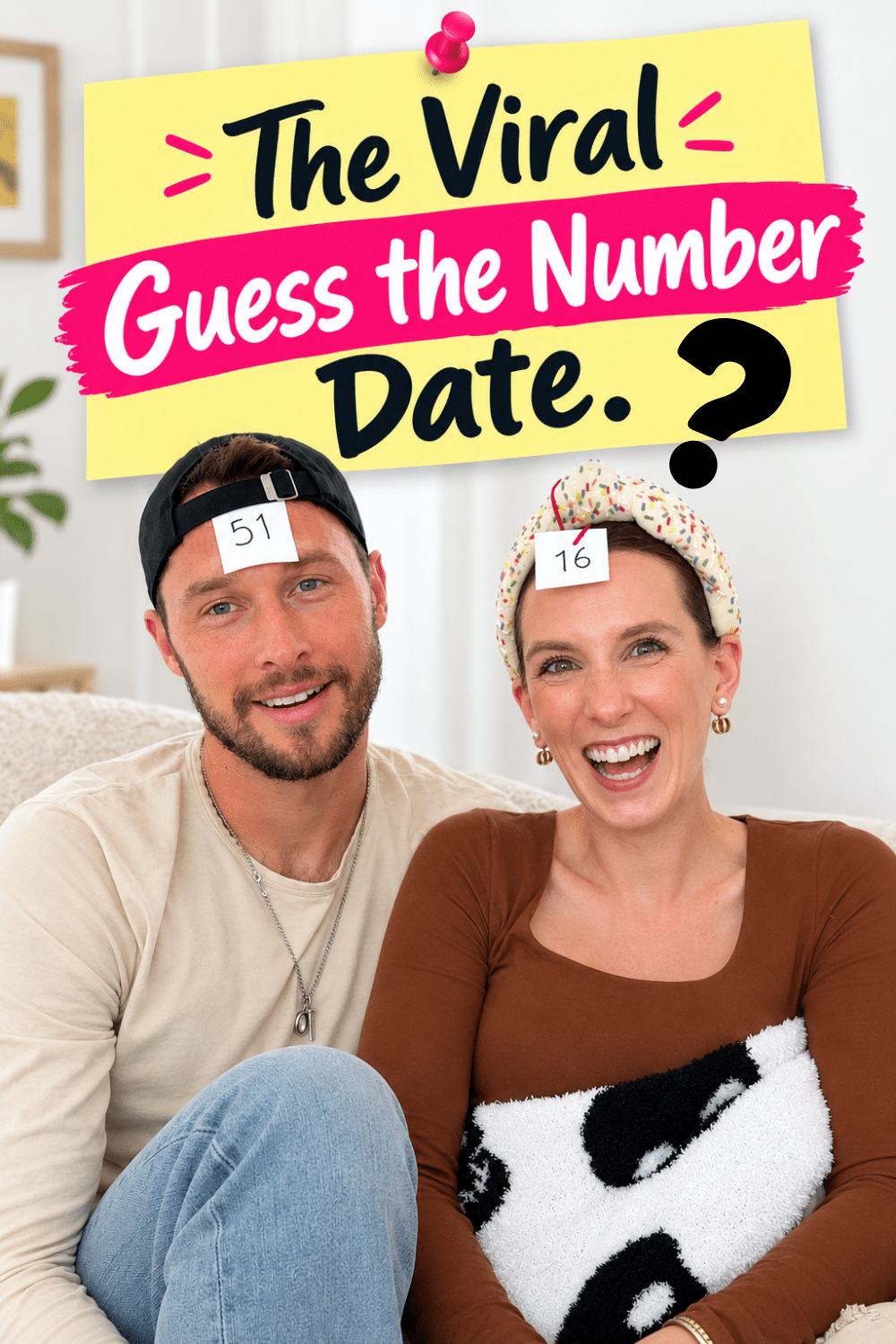
Couples all over TikTok and Instagram are sticking secret numbers on each other’s foreheads and asking the most ridiculous yes-or-no questions you’ve ever heard to figure out what it says. “Could I eat this many hot dogs in a hot dog eating contest?”“Is this a normal number of minutes for me to spend in the bathroom?” 😂
We’re calling it the Guess the Number Date, and it might be the easiest date night you’ll ever plan. All you need is a sticky note, a marker, and a spouse who’s willing to look a little silly.
But here’s the part I didn’t expect: the best rounds aren’t really about the number at all. They’re about hearing how your spouse answers questions about you. Could you actually eat 8 hot dogs? Is 25 minutes a “normal” bathroom trip for you? Your spouse has opinions. And now you get to hear them.
Watch our social media director, Kate, and her husband, Ryan, play it below- then keep reading for the full rules, 85+ funny questions, a free printable, and tips for coming up with your own questions.
I won’t spoil who won the game and figured it out first. Go watch the video. 😉
What Is the Guess the Number Game?
The Guess the Number game is a viral couples game where you each secretly write a number from 1 to 100 on a sticky note and stick it to your spouse’s forehead. Then you take turns asking silly yes-or-no questions to figure out the number on your own head– like “Could I do this many push-ups?” or “If I got this number as a test grade, would I be happy?” The first person to guess their number wins.
You’ll see it called a bunch of different things online: the number on your forehead game, the number on your head challenge, the guess the number challenge, think of a number, or just the numbers game. It’s all the same game, and it’s taken off because it’s free, it’s fast, and it is SO fun and easy to play.
The twist that makes it hilarious? No boring questions allowed. You can’t just ask “Is it higher than 50?” You have to get creative, and that’s where the fun (and a few playful arguments) comes in.
What You Need for the Guess the Number Date
You’ve got all of this in a junk drawer somewhere:
Sticky notes — or any small piece of paper.
A marker — a Sharpie works best so the number is big and easy to read from across the couch.
Tape — for when the sticky note refuses to stick. Painter’s tape is gentlest on skin. (Also, some foreheads are simply non-stick. Nobody knows why.)
Our free printable — the rules and a big list of funny questions in one place, so nobody has to think of questions on the spot. Grab it below.
Snacks — bonus points if you use them as the subject of your questions. “Could I eat this many M&Ms right now?” Then prove it.
A phone propped up to record — optional, but trust me. You’ll want to rewatch your spouse’s face when they realize what their number is.
Total cost: $0. Total prep: about 2 minutes. This is the perfect date for a weeknight when you’re both tired but still want to laugh together.
How to Play the Guess the Number Game
Agree on your range. 1 to 100 is the classic. It’s big enough to be tricky but small enough that you’ll actually figure it out before bedtime.
Secretly pick a number for your spouse. Turn around, hide behind a cabinet, do whatever it takes. Write it big on your sticky note and don’t let them see it.
Stick it on their forehead. Without letting them peek. Add tape if it starts to droop. Now you can each see your spouse’s number, but not your own.
Take turns asking yes-or-no questions about YOUR number. Every question is about you: “Do I have more than this amount of shoes?” Your spouse looks at your forehead and answers honestly based on what they know about you. Try to keep your answers to mainly yes or no only. No hints, no smirking. (Smirking will happen anyway.)
Keep going back and forth. One question each, alternating. Use every answer to narrow it down.
Guess when you think you know. On your turn, you can use it to guess instead of asking a question. Get it right and you win. Get it wrong and your turn is over.
Play again. Round two is always better because now you both know how the other one thinks.
Our House Rules
No math questions. “Is it even?” “Is it higher than 50?” “Is it a multiple of 5?” All banned. The whole point is to be creative.
Answer about your spouse, not about people in general. If the question is “Could I eat this many french fries?” the answer isn’t whether a normal human could. It’s whether they could. That’s where the good stuff comes from.
Tease, don’t wound. Keep it playful. Skip anything about weight, insecurities, or sore spots. You want your spouse laughing, not hurting.
Put something on the line. Loser does the dishes, gives a back rub, or has to let the winner pick the next date night. Stakes make everything better.
What Happened When Kate and Ryan Played
Here’s the setup: Ryan’s number was 51 and Kate’s number was 16.
And what I love about their video is how them the questions are. Kate asked whether it would be reasonable for her to own that many bags and purses. (A very important question!) Ryan asked whether he could eat that many chicken nuggets in one sitting.
But my favorite was when Ryan went straight for his own quirk: “You know my OCD with the TV volume? Would this number drive me crazy?” If you’ve ever been married to someone who has feelings about whether the volume is on 50 or 51, you know. 😂 That’s exactly the kind of question that makes this game so fun: nobody else on earth could ask it, and only your spouse can answer it.
They asked a lot of great questions, but here are a few of our favorites from their round so you can steal them:
Would it be reasonable for me to own this many bags or purses?
Can I eat this many chicken nuggets in one sitting?
You know my OCD with the TV volume? Would this number drive me crazy?
Could I eat this many cookies in a day?
If I were driving on the highway, would this be a normal speed to drive?
In a standard job, would this be a normal number of vacation days to take in a year?
Notice how the same number takes on a totally different personality depending on the question? 16 purses might be totally reasonable (I said what I said), but 16 miles per hour on the highway would get you honked at. 51 nuggets? Ambitious. 51 as a test score? Suddenly that number isn’t looking so high. That’s the secret to good questions, and it’s why this game gets so funny so fast.
📌 Save this one to Pinterest so you have the questions handy on your next date night!
85+ Funny Questions for the Guess the Number Game
The couples who have the most fun with this game aren’t the ones asking the smartest questions. They’re the ones asking questions that are a little funny and show a little bit about their spouse and their relationship. So we skipped the boring ones and went straight for the good stuff.
Every question below is asked about yourself or your marriage.
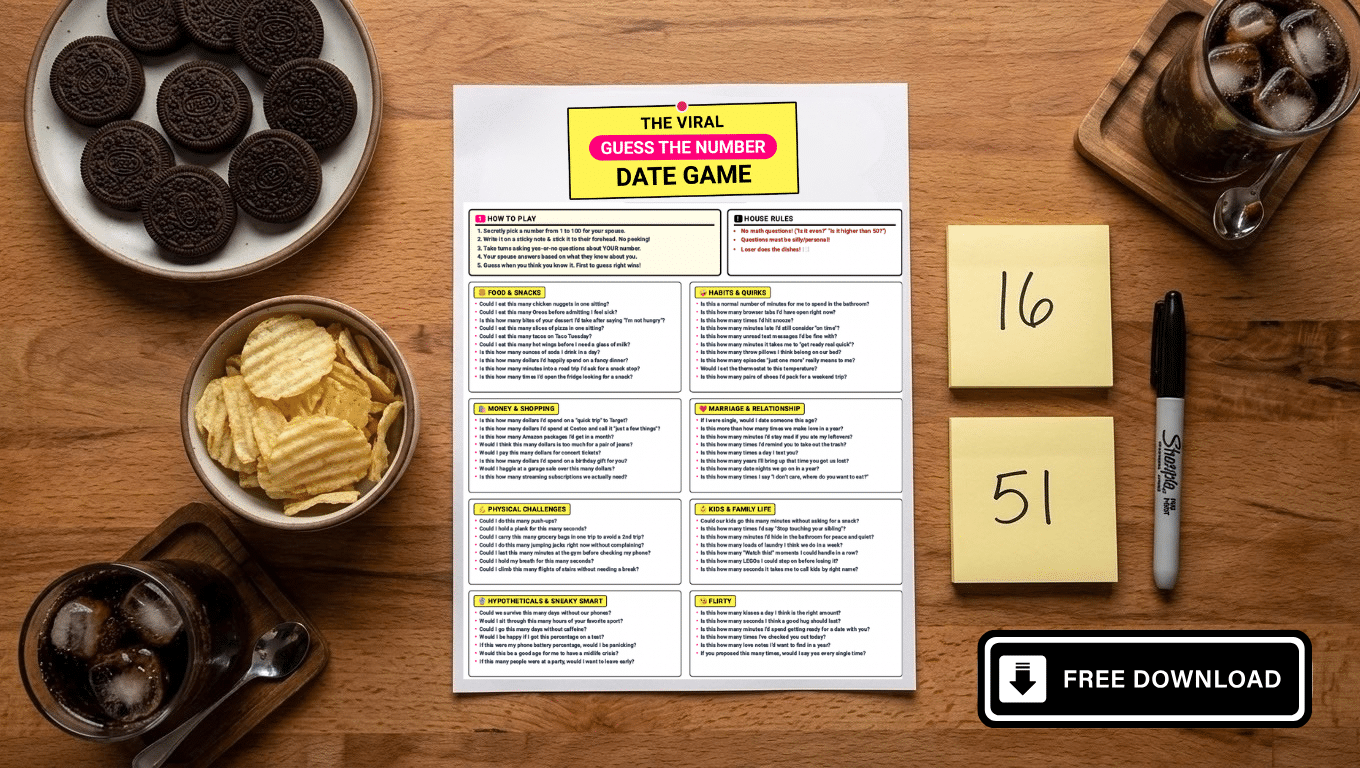
Want to skip the scrolling? Grab our free printable with the questions and the rules all in one place. Print it, leave it on the coffee table, and you’re ready for game night.
Free Printable
Guess the Number Date Printable Game
All the rules and our favorite funny questions, ready to print for your next date night.
Could I eat this many chicken nuggets in one sitting?
Could I eat this many Oreos before admitting I feel sick?
Is this how many bites of your dessert I’d take after saying “I’m not hungry”?
Could I eat this many slices of pizza in one sitting?
Could I eat this many tacos on Taco Tuesday?
Could I eat this many hot wings before I need a glass of milk?
Is this how many ounces of soda I drink in a day?
Is this how many dollars I’d happily spend on a fancy dinner?
Is this how many minutes into a road trip I’d ask for a snack stop?
Is this how many times I’d open the fridge in one evening looking for a snack?
Would I wait in line this many minutes for a famous doughnut?
Is this how many sugar packets I’d put in my coffee if nobody was watching?
Habits & Quirks Questions
Is this a normal number of minutes for me to spend in the bathroom?
Is this how many browser tabs I’d have open right now?
Is this how many times I’d hit snooze?
Is this how many minutes late I’d still consider “on time”?
Is this how many unread text messages I’d be totally fine with?
Is this how many minutes it takes me to “get ready real quick”?
Is this how many throw pillows I think belong on our bed?
Is this how many episodes “just one more” really means to me?
Would I set the thermostat to this temperature?
Is this how many minutes I’d scroll for something to watch before giving up?
Is this how many pairs of shoes I’d pack for a weekend trip?
Is this how many half-empty cups I’d leave around the house in a day?
Physical Challenge Questions
Warning: these tend to end with someone on the floor trying to prove a point.
Could I do this many push-ups?
Could I hold a plank for this many seconds?
Could I carry this many grocery bags in one trip just to avoid making a second trip?
Could I do this many jumping jacks right now without complaining?
Could I last this many minutes at the gym before checking my phone?
Could I hold my breath for this many seconds?
Could I climb this many flights of stairs without needing a break?
Could I dance nonstop at a wedding for this many minutes?
Money & Shopping Questions
Is this how many dollars I’d spend on a “quick trip” to Target?
Is this how many dollars I’d spend at Costco and still call it “just a few things”?
Is this how many Amazon packages I’d get in a month?
Would I think this many dollars is too much for a pair of jeans?
Would I pay this many dollars for concert tickets?
Is this how many dollars I’d spend on a birthday gift for you?
Would I haggle at a garage sale over this many dollars?
Is this how many streaming subscriptions I think we actually need?
Marriage & Relationship Questions
These are the ones that end up being the most revealing. And the most fun to argue about.
If I were single, would I date someone this age?
Is this how many times a week I say “I’m fine” when I’m not?
Is this how many minutes I’d stay mad if you ate my leftovers?
Is this how many times I’d remind you to take out the trash before doing it myself?
Is this how many times a day I text you?
Is this how many years I’ll keep bringing up that one time you got us lost?
Is this how many date nights we go on in a year?
Would I be happy if you planned this many date nights for me this year?
Is this how many times I’d say “I don’t care, where do you want to eat?” before we decide?
Is this how many minutes I’d need to “cool down” after a disagreement?
Kids & Family Life Questions
Could our kids go this many minutes without asking for a snack?
Is this how many times I’d say “Stop touching your sibling” on a road trip?
Is this how many minutes I’d hide in the bathroom for some peace and quiet?
Is this how many loads of laundry I think we do in a week?
Is this how many kids’ birthday parties I’d happily attend in a month?
Is this how many “Watch this!” moments I could handle in a row?
Is this how many LEGOs I could step on before losing it?
Is this how many seconds it takes me to call our kids by the right name?
Hypothetical Questions
Could we survive this many days without our phones?
Could I survive this many days on a deserted island?
Would I sit through this many hours of your favorite sport?
Could I last this many hours at a theme park before needing a nap?
Could I binge a show with this many episodes in one weekend?
Would I go tent camping for this many nights?
Could I go this many days without caffeine?
Could I go this many hours without talking?
Sneaky Smart Questions (That Still Sound Silly)
These have a built-in scale, so they narrow things down fast without breaking the no-math rule. Use one or two early, then get ridiculous.
Would I be happy if I got this percentage on a test?
If this were my phone battery percentage, would I be panicking?
Would this be a comfortable temperature outside for me?
Would this be a normal speed to drive through a neighborhood?
Would this be a good age for me to have a midlife crisis?
If this were a restaurant’s score out of 100, would I still eat there?
If this many people were at a party, would I want to leave early?
If this were the hour on a 24-hour clock, would I already be asleep?
Flirty Questions
Is this how many kisses a day I think is the right amount?
Is this how many seconds I think a good hug should last?
Is this how many minutes I’d spend getting ready for a date with you?
Is this how many times I’ve checked you out today?
Is this how many love notes I’d want to find in a year?
If you proposed this many times, would I say yes every single time?
How to Write Your Own Funny Questions
Our list will get you started, but the questions that get the biggest laughs are always the ones only you could ask. Here’s how to come up with your own on the spot:
Start with your own quirks. Just like Ryan and his TV volume. Your weird habits are the best source material. Too many water bottles in the car? Strong feelings about the thermostat? Build a question around it.
Pick something with a “normal” range. Speed limits, percentages, ages, temperatures, and prices all have a built-in sense of what’s normal. That’s what lets you narrow it down without asking a math question.
Ask questions your spouse has opinions about. “Is this an acceptable amount of Amazon packages to order in a month?” isn’t really about the number. It’s an invitation for your spouse to finally tell you the truth. 😂
Go broad first, then get specific. An early “would I be happy with this percentage on a test?” tells you a lot. Save the super-specific inside jokes for when you’re closing in.
Keep a straight face. Easier said than done. But the more serious you look while asking ridiculous questions, the funnier it gets.
Fun Ways to Change It Up
The Double Date Version — grab another couple or 2 and go around the circle. Everyone gets a number, and anyone can answer. Watching other couples describe their relationship quirks and habits is a whole new level of funny.
The Family Version — bring the kids in and use kid-friendly questions like “Could I eat this many grapes?” or “Is this how many minutes of screen time I’d want?” Kids LOVE this one.
The Long Distance Version — over FaceTime, skip the forehead. Each of you writes down a number for the other person and hides it. Then take turns asking questions like normal.
The Speed Round — set a 3-minute timer. Whoever guesses their number before the buzzer wins. Chaotic in the best way.
The Holiday Version — theme your questions. “Could I eat this many Christmas cookies?” “Is this how many Halloween candies I’d steal from the kids’ buckets?”
The After-the-Kids-Are-in-Bed Version — use only flirty or sexy questions. Winner gets to decide what happens next. 😉
Why This Game Is So Good for Married Couples
On paper, it’s just a silly guessing game. But there’s a reason couples can’t stop playing it.
You learn how your spouse sees you. Every single answer is your spouse’s take on who you are. Sometimes it’s hilarious. Sometimes it’s surprisingly sweet. Occasionally it’s “Wait, you really think I’d spend that much at Target?”
It proves how well you know each other. The whole game only works because your spouse knows your habits. It’s basically a how-well-do-you-know-me quiz in disguise. (If you love that part, play the Newlywed Game next.)
It gets you laughing together. Shared laughter is one of the fastest ways to feel close again, especially after a long week of just being co-workers running a household.
It’s playful teasing done right. Good-natured teasing is a love language all its own. This game gives you a fun, safe space to poke at each other’s quirks.
It requires basically nothing. No sitter, no money, no planning, no energy. If you’ve been in a date night rut, this is the easiest way back out.
More Free At-Home Date Nights You’ll Love
Loved another viral trend from Kate and Ryan? The Camera Roll Date Night uses two bowls and your phone’s photo library to take you both down memory lane.
Want more how-well-do-you-know-me fun?Spouse Scattergories is a hilarious game with four free printable versions.
In the mood for more guessing games?Couple’s Pictionary turns your favorite relationship memories into (terrible) drawings your spouse has to guess.
Love the forehead part?Heads Up: Spouse Edition swaps the number for a word card all about love and marriage, with free printable cards and a DIY headband.
Already have your phones out? The YouTube Scavenger Hunt Date sends you both racing through a list of ridiculous challenges.
Working your way through the alphabet? File this one under G for Guess the Number in our Alphabet Dating list of 350+ A-to-Z date ideas.
So tonight, grab a pack of sticky notes and a marker, and find out exactly how many chicken nuggets your spouse thinks you can eat. You might be surprised by the answer. ❤
Play it tonight, then come back and tell us in the comments: what was the funniest question you asked, and how many guesses did it take?
Guess the Number Game FAQ
Tap any question to see the answer.
What is the guess the number game?
The guess the number game is a viral couples game where each person secretly writes a number from 1 to 100 on a sticky note and sticks it to their partner’s forehead. You take turns asking creative yes-or-no questions about yourself, like “Could I eat this many chicken nuggets?”, and your partner answers based on the number they can see. The first person to correctly guess their own number wins.
What is the number on your forehead game called on TikTok?
It doesn’t have one official name. On TikTok and Instagram you’ll see it called the guess the number challenge, the number on your forehead game, the number on your head challenge, think of a number, or simply the numbers game. They all describe the same game: a secret number on your forehead and silly yes-or-no questions to figure it out.
What number range should you use?
Most couples use 1 to 100. It’s wide enough to make the game challenging but small enough that you’ll usually figure it out in 10 to 20 questions. For a quicker game or for playing with kids, try 1 to 50.
Can you ask “Is it higher or lower than 50?”
Technically you can, but most couples ban it. The viral version of the game has one big rule: no basic or math questions like “Is it even?” or “Is it higher than 50?” Instead, you have to narrow it down with creative questions about yourself, which is what makes the game so funny.
What are good questions for the guess the number game?
The best questions are personal and a little funny. Try “Could I eat this many chicken nuggets in one sitting?”, “Is this a normal number of minutes for me to spend in the bathroom?”, “Would I be happy with this percentage on a test?”, “If I were single, would I date someone this age?”, or “Is this how many dollars I’d spend on a quick trip to Target?” Questions tied to your own quirks get the biggest laughs.
Who answers the questions?
Your spouse does. You ask a question about yourself, and your spouse looks at the number on your forehead and answers yes or no based on what they know about you. That’s what makes it a great couples game. You’re really hearing how your spouse sees you.
How long does the guess the number game take?
A single round usually takes 5 to 15 minutes, depending on how creative your questions are. Setup takes about two minutes. Most couples play several rounds, so plan on 30 minutes to an hour for a full date night.
What if the sticky note won’t stay on my forehead?
Add a small piece of tape. Painter’s tape is gentlest on skin. You can also hold the note up to your forehead, wear it on a headband, or skip the forehead entirely and have your spouse just keep the number hidden while they answer.
Can you play the guess the number game with a group or with kids?
Yes. For a group or double date, everyone gets a number and anyone in the circle can answer each question. For kids, use a smaller range like 1 to 50 and simple questions such as “Could I eat this many grapes?” or “Is this how old Grandma is?”
Is the guess the number game a good date night idea?
It’s one of the easiest at-home date nights there is. It costs nothing, takes two minutes to set up, doesn’t need a babysitter, and gets you laughing together while learning how well you really know each other.
Reader Favorites
Our most-loved bedroom games & date-night ideas for couples:
You may keep dating the same type because your attention, preferences, social circles, and familiar relationship patterns repeatedly steer you toward similar people. Research suggests that many people show some consistency across partners, but a “type” is not destiny or a diagnosis. The useful task is to separate harmless preferences from recurring dynamics that leave you unhappy, unsafe, or emotionally stuck.
Recognizing your usual type can help you separate healthy preferences from patterns worth changing.
Quick Answer
People often date a similar type because attraction is shaped by stable preferences, similarity, familiarity, opportunity, and the traits they notice first. A nine-year study found some distinctive similarity between participants’ former and current partners’ self-reported personalities. That does not prove you unconsciously recreate childhood relationships, have a particular attachment style, or choose badly. Look beyond appearance and ask what actually repeats: values, availability, communication, pace, conflict, or the role you take. Keep preferences that support you, and interrupt patterns that repeatedly undermine your needs.
Key Takeaways
Having a type is common and can include personality, lifestyle, values, appearance, or relationship dynamics.
Actual partners may resemble one another, but the similarity is usually partial rather than proof of a fixed script.
Stated preferences do not perfectly predict whom you will like during a real interaction.
A repeated trait is not automatically a problem. The outcome and relationship pattern matter more.
You can widen your choices by changing your filters, settings, pace, and evaluation criteria.
What Does “My Type” Actually Mean?
Your type is the cluster of qualities you repeatedly notice, desire, choose, or encounter in potential partners. It can include visible features, humor, ambition, beliefs, emotional style, age, interests, or the way someone makes a first conversation feel.
It helps to distinguish three different kinds of repetition:
Preference repetition: You consistently like certain qualities, such as curiosity, warmth, or an outdoorsy lifestyle.
Opportunity repetition: Your app filters, neighborhood, profession, hobbies, and social network expose you to similar people.
Dynamic repetition: The relationship follows a familiar pattern, such as chasing inconsistent attention, avoiding difficult conversations, or becoming responsible for the other person’s emotions.
These categories can overlap. You might genuinely prefer creative people, meet many of them through your work, and also repeatedly overlook poor communication because early chemistry feels intense. Naming the exact repetition is more useful than simply saying, “I always pick the same person.”
Do People Really Keep Dating the Same Type?
Research suggests that some people do show measurable consistency across partners, although the effect should not be exaggerated. In a nine-year German longitudinal study, psychologists Yoobin Park and Geoff MacDonald compared former and current partners using the partners’ own personality reports. They found a significant degree of distinctive similarity between the partners, even after accounting for resemblance to the average person and to the participant.
The finding supports the idea that people can have a recurring personality type. It does not mean every ex is interchangeable, that appearance always repeats, or that the same mechanism explains everyone’s choices. The study also found weaker partner similarity among people higher in extraversion or openness, although that individual-difference result was not consistent across every analysis.
Preferences also include similarity to ourselves. A 2023 study of 1,014 single adults in China found that participants generally preferred ideal partners who resembled them in personality, physical attractiveness, and social resources. Preferences for similarity were especially strong for honesty-humility and openness. Because this was a study of ideals in one national sample, it cannot tell us exactly whom every participant later dated.
Why Do You Keep Choosing Similar Partners?
Your preferences may be relatively stable
Some qualities remain appealing because they fit your values, identity, or desired life. If you value intellectual curiosity, emotional warmth, or a particular pace of life, choosing people with those traits may be sensible. A stable preference is not something you need to eliminate merely because it repeats.
Similarity can feel easier to understand
Shared values, interests, and communication habits can make interaction smoother. Similarity may also feel validating because another person understands the assumptions that guide your decisions. However, similarity in one domain does not guarantee compatibility in another. Two adventurous people can still disagree about commitment, money, or how to repair conflict.
Your environment narrows the pool
Dating choices happen within a real opportunity structure. App filters, algorithms, location, work, friends, and hobbies determine whom you repeatedly see. If your matches have the same lifestyle or presentation, your selection process may be creating the pattern before a conversation begins.
Familiar signals are easier to notice
Attention is selective. When a certain style, voice, sense of humor, or social energy already means “attractive” to you, it may stand out faster than quieter qualities. That quick recognition can make one kind of person feel exciting while potentially compatible people receive less attention.
Early chemistry can hide the trait that matters
A repeated pattern may be carried by something less obvious than appearance. You may choose very different-looking partners who are all inconsistent, conflict-avoidant, highly critical, or unavailable for the relationship you want. Conversely, several partners may look similar but treat you in completely different ways.
This is why it helps to understand the different forms of attraction and to separate visual appeal from emotional compatibility, sexual attraction, shared values, and relationship readiness.
Your Ideal Type Does Not Perfectly Predict Real Attraction
What people say they want and whom they respond to in person are related imperfectly. A major review and meta-analysis by Paul Eastwick and colleagues found that physical attractiveness predicted romantic evaluations for both men and women, while earning prospects had a smaller association. More broadly, the review explains that ideal preferences predict outcomes differently depending on the stage of the relationship and how preferences are measured.
In practical terms, your checklist is not a complete model of your attraction. Live interaction introduces humor, timing, responsiveness, voice, scent, ease, and countless contextual details. That is one reason a person outside your usual type can become appealing over several meetings. It is also why matching every stated preference does not guarantee connection.
If you want to understand whom you notice first, the Mingle2 guide Crushes Are Not Random explores how proximity, similarity, and timing can shape attraction.
When Is Having a Type a Problem?
A type becomes worth changing when the repeated pattern conflicts with your values, safety, or relationship goals. The fact that several partners share dark hair, a profession, or a favorite hobby is usually less important than whether you repeatedly accept dishonesty, contempt, coercion, inconsistency, or incompatible plans.
What repeats
Usually a preference
Potentially harmful pattern
Appearance or style
You enjoy a certain look without ignoring character
You dismiss compatible people automatically or equate a look with trustworthiness
Lifestyle
You choose people whose routines fit yours
You repeatedly choose excitement that conflicts with your stated goals
Emotional availability
You respect a gradual pace with growing consistency
You keep pursuing people who offer intermittent attention and avoid clarity
Your role
Care and effort are mutual
You repeatedly rescue, manage, persuade, or prove your worth
Conflict
Both people can repair after disagreement
The same criticism, withdrawal, fear, or boundary violation returns
Fear of being single can also affect selectivity. Across several studies, Stephanie Spielmann and colleagues found that greater fear of being single was associated with settling for less in relationships and, in a speed-dating study, expressing romantic interest less selectively. This does not mean that staying in an imperfect relationship proves fear or that selectivity is always healthy. It suggests one question to consider: are you choosing this person because the relationship fits, or because any relationship feels safer than being single?
How to Break an Unhelpful Dating Pattern
1. Audit outcomes, not just appearances
List your last three meaningful dating experiences. For each one, record what attracted you, what became difficult, how conflict was handled, whether words matched actions, and why it ended. Look for repeated behaviors and roles. Avoid diagnosing your exes from a distance.
2. Separate requirements from packaging
Create two short lists. The first contains relationship requirements, such as kindness, consistency, compatible commitment, respect for boundaries, and a workable lifestyle. The second contains preferred packaging, such as a certain profession, fashion style, height, or conversational energy. Do not pretend appearance never matters. Instead, make sure packaging is not outranking what sustains a relationship.
3. Change one source of repetition
Widen one app filter, try a new activity, ask friends for introductions outside your usual circle, or initiate conversations with profiles you would normally overlook. On Mingle2, adjust one preference at a time so you can notice what actually changes.
4. Give moderate attraction enough information
If there is basic interest, respect, and safety, consider two or three low-pressure meetings before deciding that a person is not your type. This is not an obligation to force attraction. It is a way to collect more information when the first impression is neutral rather than negative.
5. Add behavior-based questions
Replace “Are they my type?” with more useful questions:
Do their actions become more consistent as we get closer?
Can we discuss needs without punishment, ridicule, or disappearing?
Are effort and curiosity mutual?
Do I like who I become around them?
Are our relationship goals compatible now, not hypothetically?
6. Notice when intensity is doing the deciding
Strong uncertainty can feel mentally absorbing, but preoccupation is not the same as compatibility. If one person’s distance makes you chase harder, slow the pace and evaluate what is actually available. The Mingle2 article Why Some People Are So Hard to Let Go Of offers more context for persistent attachment after a difficult connection.
7. Get support when the cost is high
A therapist can help when the pattern involves abuse, coercion, trauma, severe anxiety, or repeated relationships that undermine your safety. Therapy is not required simply because your partners have similarities. Seek urgent local support if a partner threatens, controls, stalks, or harms you.
Summary
You may keep dating the same type because stable preferences, similarity, selective attention, your environment, and familiar relationship dynamics repeatedly shape your choices. Research provides some evidence that people’s former and current partners resemble one another in personality, but the pattern is not absolute. Your stated ideal also cannot fully predict attraction in real interactions. Instead of trying to date the complete opposite of everyone you have liked, identify what actually repeats. Preserve qualities that support your values, and change the filters, pace, or decisions that lead to the same painful outcome. The goal is not to eliminate your type. It is to make your choices more conscious and compatible with the relationship you want.
Frequently Asked Questions
Does everyone have a type?
Not everyone has a narrow or easily described type, but many people show recurring preferences. Those preferences may concern personality, values, lifestyle, appearance, or interaction style. They can also change with experience and context. A type is best understood as a tendency, not a rule that predicts every person you will find attractive.
Is dating the same type caused by attachment style?
Attachment tendencies may influence how some people respond to closeness, dependence, or conflict, but dating a similar type does not establish an attachment style. Opportunity, values, appearance preferences, and social environment can also explain repetition. Avoid diagnosing yourself or a partner from one pattern. Focus first on observable behavior and outcomes.
Should I date the opposite of my usual type?
Not automatically. Choosing the opposite on every dimension can discard healthy preferences without addressing the harmful dynamic. Keep requirements that support compatibility, then experiment with less important filters or first-impression habits. The useful opposite of inconsistency is consistency, not necessarily a different hairstyle, profession, or personality.
Can your type change over time?
Yes. Preferences can shift as your values, social environment, relationship goals, and experiences change. You may also discover that qualities you once overlooked predict a better relationship for you. Change does not require forcing attraction. It can begin by giving different people a fair opportunity and evaluating them with clearer criteria.
Why do people outside my type sometimes become attractive later?
Real interaction provides information that a profile or first glance cannot. Humor, responsiveness, familiarity, shared experience, and emotional connection may increase attraction. This does not happen with everyone, and you do not owe anyone romantic interest. It simply shows that initial visual preference is only one part of attraction.
How do I know whether the pattern is unhealthy?
Look at repeated outcomes. A pattern deserves attention when you repeatedly feel unsafe, dismissed, controlled, confused, depleted, or unable to express needs, especially when the same boundary violations or incompatible goals return. Similar harmless traits are less important than recurring behavior that damages your wellbeing.
References
Park, Y., & MacDonald, G. (2019). Consistency between individuals’ past and current romantic partners’ own reports of their personalities. Proceedings of the National Academy of Sciences, 116(26), 12793–12797. PubMed. DOI: 10.1073/pnas.1902937116.
Liu, J., & Zhang, Y. (2023). Singles’ similarity preferences in an ideal partner: What, when, and why. Frontiers in Psychology, 14, 1088591. PubMed Central. DOI: 10.3389/fpsyg.2023.1088591.
Eastwick, P. W., Luchies, L. B., Finkel, E. J., & Hunt, L. L. (2014). The predictive validity of ideal partner preferences: A review and meta-analysis. Psychological Bulletin, 140(3), 623–665. PubMed. DOI: 10.1037/a0032432.
Spielmann, S. S., MacDonald, G., Maxwell, J. A., Joel, S., Peragine, D., Muise, A., & Impett, E. A. (2013). Settling for less out of fear of being single. Journal of Personality and Social Psychology, 105(6), 1049–1073. PubMed. DOI: 10.1037/a0034628.