If you’re single and genuinely want to meet a great woman, ask yourself:
Are you actually showing up as the man you want to be?
Dating isn’t just about finding the right woman.
It’s about becoming the kind of man who is ready for the right relationship.
That means:
✔️ Getting clear on what you actually want ✔️ Taking dating seriously rather than leaving it to chance ✔️ Having the confidence to approach, communicate and make a move ✔️ Being decisive instead of endlessly messaging ✔️ Taking responsibility for your dating patterns ✔️ Knowing your standards — and respecting hers ✔️ Stepping into your masculine energy and leading.
Women don’t want to do all the work.
They don’t want to chase.
They don’t want to constantly wonder where they stand.
They want a man who is confident, intentional, emotionally mature and prepared to step up.
So, if you’ve been saying “I just haven’t met the right woman yet…”
Maybe September is the month to look at yourself.
💥 Stop waiting. Start dating differently.
I work with men who want to improve their confidence, communication and dating skills — and ultimately become more successful in finding a meaningful relationship.
Have you ever fantasized about the Hugh Hefner lifestyle?
Picture it: you’re an older guy, walking into high-status venues or hosting elite gatherings, surrounded by a rotation of stunning, energetic 20-something women who are genuinely excited to be in your orbit.
Most men assume this lifestyle is reserved strictly for tech billionaires, Hollywood producers, or guys born into royalty. They think, “If I don’t have a $50 million mansion or a private jet, why would young models want to hang around me?”
Here is the truth: You don’t need a billion dollars to create the Hugh Hefner Effect.
As a 43-year-old guy who regularly constructs these exact dynamics, I’m going to reveal the step-by-step “lifestyle setup” system that allows any mature man to build a high-status social circle of young, attractive women.
CRITICAL PRE-REQUISITE:
Before we touch the mechanics, understand this: No lifestyle system can fix weak internal confidence.
Think of this process like high-level marketing and sales. If your “product”, meaning your foundational mindset, body language, and masculine presence is lacking, throwing women into your funnel only leads to immediate buyer’s remorse.
Build your personal foundation first; use this strategy to amplify it.
Step 1: Fill the Funnel (Lead Generation)
To build a high-status social circle, you must treat your social life like a pipeline. You need a steady stream of new connections coming in through multiple channels.
In-Person Approaches: Walk up, start dynamic conversations, and exchange contact information with women you meet throughout your daily life—cafes, high-end venues, and events.
The “Friendship Pivot”: If you meet an attractive woman who isn’t a direct romantic fit, keep her in your circle anyway. Beautiful women know other beautiful women. Befriending well-connected women expands your organic reach exponentially.
Outsource Online Dating: Set up a system (or use an automated dating workflow with a virtual assistant) to handle the repetitive swiping, matching, and initial scheduling across dating apps so your inbox fills up on autopilot.
Leverage Existing Events: Attend high-end networking mixers, gallery openings, and venue launches. Focus on connecting socially rather than hunting for individual dates.
Step 2: The Barter System (Leveraging Capital)
You don’t need to drop $10,000 on a VIP table or own a $5 million yacht to host a high-status gathering. You just need to understand The Value Barter System.
Ultra-wealthy men usually have access to incredible assets—penthouses, yachts, luxury villas, and VIP club tables but they often lack one crucial element: a vibrant, energetic social atmosphere filled with attractive people.
Connect with high-net-worth venue owners or hosts. You bring the curated social energy and stunning guests; they supply the venue, luxury environment, and logistics. Both parties win, and your personal capital expenditure stays minimal.
Step 3: Execute the High-Status Event
Once the location is secured, it’s time to activate your funnel.
Systematize Invitations: Have your virtual assistant or team reach out to your contact list with clean, professional details about the upcoming event.
Set Clear Expectations: Frame the event as an exclusive, high-energy social gathering rather than a standard “date.”
Host with Presence: On the day of the event, step into the role of the master of ceremonies. Connect people, maintain high group energy, and let the social proof of the room do the heavy lifting for your personal attraction.
Want Live Coaching? Book a free 15 Minute Consultation Call
Step 4: The Aftermath & The “FOMO” Loop
The event doesn’t end when the lights go up. The most powerful phase happens in the 48 hours following the gathering.
Capture crisp, high-quality photos and short video clips during the event. Share them across your social media channels and tag attendees.
This creates a powerful FOMO (Fear Of Missing Out) feedback loop:
Women who attended post about the incredible experience, cementing your status as a high-value host.
Women in your funnel who didn’t attend see the social proof, making them significantly more eager to join the next invitation.
Your outreach response rates double because your lifestyle speaks for itself.
What Happens When She Asks About Your Age?
Building a dynamic lifestyle circle with younger women naturally leads to one specific question during conversation: “So… how old are you?”
If you hesitate, get defensive, or try to hide your age, you instantly destroy your masculine authority. Mature age is an advantage—if you frame it correctly.
If you want to master these high-status mindsets and become the man that women chase, click the banner below to learn more about our live coaching program.
The week ahead is already stacked up in front of you like a pile of laundry. Somebody has a dentist appointment. Somebody needs cleats. There’s a thing on Thursday you keep forgetting about. You’ll figure it out in the family group chat tomorrow, probably.
And the two of you, the actual couple at the center of all this, will get about nine minutes of each other’s undivided attention between now and next Sunday. Most of it while brushing your teeth.
That’s not a marriage problem. That’s alogistics problem that eventually becomes a marriage problem.
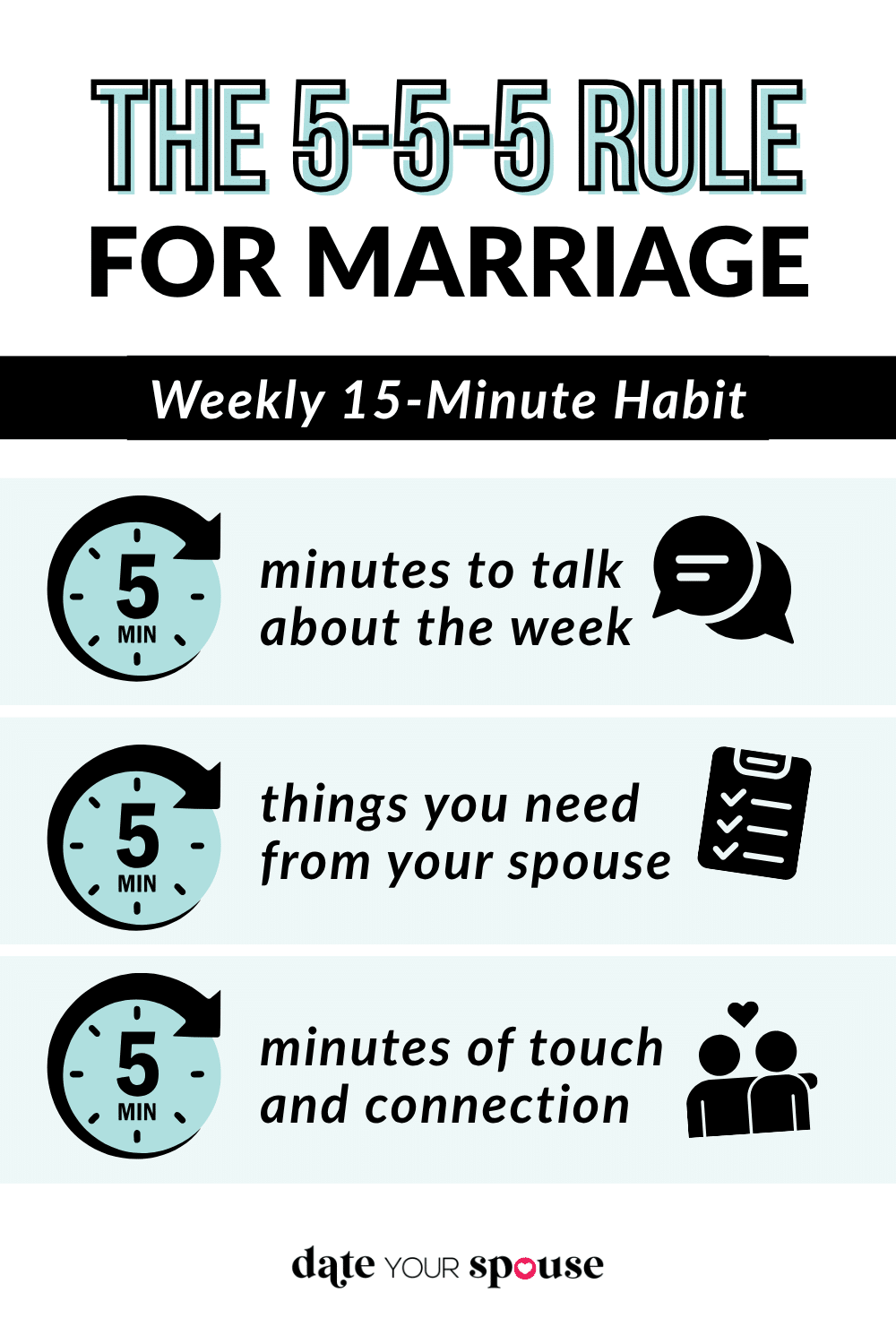
So here’s the fix, and it is almost too simple. It’s called the 5-5-5 rule, it takes fifteen minutes, and you do it once a week.
That’s it. Fifteen minutes. One night a week. We’ve watched this one small habit do more for couples than an entire marriage book- not because it’s clever, but because it’s small enough that you’ll actually do it.
What Is the 5-5-5 Rule in Marriage?
The 5-5-5 rule is a weekly, fifteen-minute marriage routine made of three five-minute parts:
5 minutes to talk about the week together — what’s coming, what’s heavy, what you’re looking forward to.
5 things you need from your spouse this week, said out loud — actually spoken, not hinted at.
5 minutes of physical connection with no agenda — touch that isn’t going anywhere and isn’t asking for anything.
Sunday evening is the natural home for it, because you’re standing at the front edge of the week instead of the wreckage of it. But the day matters far less than the repeat. Tuesday-night couples do just as well as Sunday-night couples. Couples who “do it when we get a chance” do not.
Why Fifteen Minutes Actually Works
Fifteen minutes sounds too small to matter. That’s exactly why it works.
Most marriage advice fails at the same spot: not motivation, but capacity. You already want to connect with your spouse. At 9pm on a Sunday you just don’t have a weekend retreat, a therapist’s opening, or the emotional bandwidth for a two-hour State of the Union. So the connection becomes a thing you’ll get to later, and later quietly becomes three years.
The Gottman Institute has a phrase for the antidote: small things often. Their decades of research keep landing on the same unglamorous conclusion- tiny, frequent moments of turning toward each other predict lasting happiness far better than occasional grand gestures do. A surprise trip to Cabo is wonderful. But it is not what keeps you close in March.
The 5-5-5 rule is “small things often”, put on a calendar.
And notice what it covers:
One block for your logistics
One block for your needs
One block for your bodies
Those are the three places marriages drift apart, and most couples are only maintaining the first one. If that sounds familiar, you may be further into roommate syndrome than you realized, and this routine is one of the cleanest ways out of it.
The First 5: Five Minutes to Talk About the Week Together
Time: 5 minutes. Difficulty: easy — as long as you don’t let it become a big scheduling meeting.
Sit down together. Set a timer for five minutes and talk about the week ahead.
Here’s the trap, and nearly every couple falls into it the first time: this turns into a giant calendar review. Carpool, soccer, the dentist, who’s picking up the prescription. If the entire discussion is pure administration, you will both walk away feeling like you just had a staff meeting with someone you’re married to.
Logistics are necessary, but connection is the main point.
So anchor the conversation with three questions instead:
What’s the hardest thing on your plate this week? (What feels heavy?)
What are you actually looking forward to? (If nothing, what can we add that would be fun or rewarding?)
Where do you most need me to have your back? (What should I be aware of?)
Those three questions get you somewhere a shared Google Calendar never will. You stop tracking your spouse’s schedule and start tracking their actual week– the pressure of it, the dread of it, the one good thing they’re holding onto.
One rule while your spouse is answering: don’t fix anything. Don’t problem-solve, don’t optimize their Thursday, don’t suggest they just wake up earlier. Just listen and say something like “that sounds like a lot.” Most of us aren’t really listening when our spouse talks, we’re loading our response. And our spouses can always tell. If that’s a habit worth breaking, our guide to active listening is worth five minutes of your week.
If this feels awkward at first, that’s normal. It usually starts to feel more natural by week three.
The Second 5: Five Things You Need From Your Spouse, Said Out Loud
Time: 5 minutes. Difficulty: the hardest of the three, by a mile.
Each of you names five things you need this week. Out loud. Specific. To their face.
This is where couples squirm, and the reason is worth sitting with. Most of us were quietly taught that a good spouse shouldn’t have to ask- that if they really loved you, they’d notice. So instead of asking, we hint. We sigh at the dishes. We mention offhand that so-and-so’s husband planned a whole date night. We wait to be read like a book, and then feel unloved when we’re not.
Hinting is not communication. It’s a test your spouse doesn’t know they’re taking.
Say the thing.
And say it as a request, not a review of their performance:
Instead of “you never help with bedtime” → “I need you to take bedtime on Wednesday so I can breathe.”
Instead of “we never talk anymore” → “I need twenty minutes with you after the kids are down on Tuesday.”
Instead of “you’re always on your phone” → “I need your eyes when I’m telling you about my day.”
Instead of “you don’t find me attractive anymore” → “I need you to flirt with me this week. Actually flirt.”
Same topic. Completely different conversation. One puts your spouse on the defensive; the other puts them on your team.
Three ground rules make this block safe enough to keep doing:
Keep them small. Five needs for one week means five doable things, not five huge overhauls. “Text me at lunch” is a perfect entry.
No defending. The listener’s only job is to hear it and say “got it.” Not “well, I would have, but—”. You can discuss it later in the week if you need to.
No scorekeeping. If your spouse only gets to three of their five, they’re not failing. This is a habit, not a performance review.
One more thing worth watching for: sometimes this block surfaces friction. That’s not the routine failing- that’s the routine working. A need you can say out loud is a need your spouse can actually meet. A need you swallow just turns into resentment with a longer fuse.
The couples who worry us aren’t the ones who disagree. They’re the ones who have quietly stopped bringing up anything that might turn into a fight. That feels like peace for a while, and then one day you look up and realize the only safe topic left is the calendar. Your marriage cannot get better at something neither of you is willing to be honest about. So if this block gets uncomfortable, read it as proof you’ve built enough safety to be honest with each other. Here’s why conflict in marriage isn’t the enemy and what healthy disagreement actually looks like.
The Third 5: Five Minutes of Physical Connection With No Agenda
Time: 5 minutes. Difficulty: requires some honest self-examination.
Five minutes of touch that is not going anywhere.
Hold each other on the couch. Sit with their head in your lap. Slow dance in the kitchen to one song. Hold hands and say nothing at all. The specific activity matters far less than the thing you’re proving: I want to be close to you for its own sake.
Here’s why this block matters more than it looks. In a lot of marriages, touch has quietly become transactional. A hand on the back, a shoulder rub, a hug from behind at the sink- and both people know it’s a bid for something else. So the receiving spouse learns to brace. And once touch reliably means a negotiation is starting, it stops functioning as affection at all.
Which is why the trap to watch for is offering non-sexual touch as a strategy. If the thinking underneath it is if I do more of this, I’ll get more of that, it won’t work- and it often makes things worse, because your spouse can feel the agenda underneath your hand. Touch given to earn something isn’t a gift. It’s an invoice.
Here’s a trick that makes this block startlingly effective, and you can test it in about ten seconds. While you’re touching your spouse, deliberately think about what you adore about them– something you admire, something you find attractive, something you’re grateful for. The physical touch is identical. What it communicates is not. Your spouse can absolutely feel the difference between an arm around the shoulder and an arm around the shoulder that means I’m so glad you’re mine.
The no-agenda rule is the whole point of this block, so protect it. If these five minutes always turn into expected sex, one of you may start dreading them- and you’ll have accidentally rebuilt the exact transaction you were trying to undo. If things go somewhere on their own some weeks, wonderful. But the five minutes have to be able to end at five minutes.
What you’re rebuilding is a signal that got scrambled somewhere along the way: I touch you because you’re mine, not because I want something.
How to Start the 5-5-5 Rule This Sunday
Don’t announce a whole new marriage initiative. Try this instead:
Pick your fifteen minutes. Sunday after the kids go down is the classic. Put it in your phone as a repeating event so neither of you has to remember it.
Ask small. “Can I steal fifteen minutes with you Sunday? I read about something I want to try.” That’s the entire pitch.
Set an actual timer. It sounds clinical. But it’s really the opposite- a timer means neither of you is wondering how long this is supposed to go, which is what makes it feel safe to be honest.
Do all three blocks in order. The order isn’t accidental. Talking earns the honesty; honesty earns the closeness. Skipping to block three when you haven’t done blocks one and two is why so many couples feel distant.
Commit to four weeks before you judge it. Week one is awkward. Week two is better. Somewhere around week three, most couples stop needing the timer.
And if the whole thing falls apart one week? Start again the next Sunday. The couples who win at this aren’t the ones who never miss. They’re the ones who stay consistent.
What If My Spouse Thinks It’s Cheesy?
Lead with the fifteen minutes, not the whole 3-part framework. Nobody resists fifteen minutes. What people resist is the implication that something is wrong.
So don’t open with “we have a communication problem.” Open with “I love you and I miss you. Fifteen minutes on Sunday?” You can call it the 5-5-5 rule later, once it’s already working and they’re the one reminding you about it.
What If We Keep Forgetting?
Then the problem isn’t your marriage- it’s your memory, and that’s an easier thing to fix. Set a recurring Sunday alarm labeled something you’ll actually smile at. Attach it to something you already do every week without fail.
This is the same gap our Spark’d app was built to fill- it hands you a question or a game every day so neither of you has to invent one when your brain is empty at the end of the day. Take the deciding off your plate and the doing gets a whole lot easier.
The 5-5-5 Rule: FAQs
Does the 5-5-5 rule have to be on Sunday?
No. Sunday works well because you’re at the front edge of the week rather than the end of it, so the needs you name still have time to happen. But any consistent night beats an inconsistent Sunday. Pick the night you’re least likely to cancel.
What if we can’t think of five needs?
Name two or three then. Five is a target, not a quota. And if you can barely get to three the first week- that itself is useful information the routine gives you. The number climbs naturally once asking stops feeling risky or dangerous.
Is fifteen minutes a week really enough to change a marriage?
It’s not enough to be your whole marriage- it’s not a replacement for date night, and it won’t resolve a serious ongoing conflict. What fifteen consistent minutes does is stop the drift. Most couples don’t lose each other in a blowup; they lose each other in a thousand tiny absences. The 5-5-5 rule puts a floor under that.
What if my spouse won’t do it with me?
Run your half anyway. Ask them the three questions in the car. Say your needs out loud without requiring them to say theirs. Touch them with no agenda. Marriages are systems- change one side and the other side moves. Give it a few weeks before you evaluate.
Can the 5-5-5 rule work if we’re long distance or traveling?
Yes, with one swap. Blocks one and two work fine over a video call. For block three, substitute five minutes of undivided attention with no agenda- camera on, no multitasking, no logistics. Not the same as touch, but it protects the same principle.
How is this different from a regular weekly check-in?
Most weekly check-ins are really family business meetings- calendar, money, kids. Useful, but they treat your marriage like a company you co-own. The 5-5-5 rule deliberately adds the two things a business meeting never covers: what you personally need, and physical closeness. That’s the difference between running your life well and staying in love while you do it.
Try the 5-5-5 Rule This Sunday
Fifteen minutes. Five to talk, five to ask, five to just be close.
Nobody is going to email you when your marriage is behind. There’s no deadline, no alert, no manager checking in on the two of you. That’s precisely why the relationship is the thing that quietly slides while everything with a due date gets handled.
So give it a deadline. Sunday, fifteen minutes, on the calendar, on repeat.
Limerence is an involuntary fixation driven by longing, uncertainty, and the hope that another person will reciprocate. Love can also feel intense, but it becomes increasingly grounded in knowing the real person, caring about their well-being, respecting boundaries, and building a relationship through consistent choices.
The two can overlap, especially at the beginning of a romance. The clearest question is not “How strong are my feelings?” but “Are these feelings helping me relate to the person as they really are?”
Limerence is often fueled by idealization and uncertainty, while love develops through reality, mutual care, and consistent connection.
Quick Answer
The main difference between limerence and love is the center of attention. Limerence centers on what the other person might feel, what their signals might mean, and whether they will finally choose you. Love centers more on who both people actually are, how they treat each other, and whether the relationship works in real life.
Limerence often includes intrusive thoughts, idealization, emotional highs and lows, and a powerful need for reciprocation. Love may include passion and longing, but it also makes room for reality, mutual care, autonomy, boundaries, and difficult information.
Neither intensity nor “butterflies” proves that a connection is love. A feeling can be sincere and powerful without being evidence of compatibility or mutual commitment.
Key Takeaways
Limerence is a descriptive psychological concept, not a formal mental health diagnosis.
Its core features include intense longing for reciprocation, preoccupation, idealization, and emotional dependence on another person’s perceived signals.
Love is broader than a feeling. Research describes love through elements such as passion, intimacy, care, responsiveness, and commitment.
Limerence and love are not perfect opposites. Limerence can occur at the start of a real relationship, coexist with love, or remain attached mainly to fantasy.
Uncertainty often sustains limerence. Clear, consistent reciprocity gives people more reality to work with.
Strong feelings do not create consent, compatibility, or an obligation for the other person to respond.
If the fixation is affecting sleep, appetite, work, relationships, or personal boundaries, support from a licensed mental health professional may help.
What Is Limerence?
Psychologist Dorothy Tennov introduced the term limerence in her 1979 book Love and Limerence. She used it to describe an involuntary state of intense romantic longing in which a person becomes highly focused on whether their feelings will be returned.
Limerence is more specific than simply having a crush. Common features include:
persistent, intrusive thoughts about one person
a strong craving for emotional reciprocation
idealizing the person or minimizing incompatibilities
repeatedly replaying conversations and imagining future scenes
searching for hidden meaning in messages, eye contact, likes, or silence
euphoria after a hopeful signal and despair after distance or ambiguity
difficulty concentrating on work, sleep, friendships, or everyday responsibilities
The person at the center of the fixation is sometimes called a “limerent object.” That phrase comes from limerence literature and online communities. It is not a clinical label, and it can sound dehumanizing. In everyday writing, “the person you are focused on” is usually clearer and more respectful.
Is Limerence Recognized by Psychology?
Limerence is a psychological concept, but it is not a diagnosis in the Diagnostic and Statistical Manual of Mental Disorders (DSM). Research on it remains limited compared with research on attachment, romantic love, or obsessive-compulsive disorder.
A 2024 systematic scoping review found that the scholarly literature was still unusually small and spread across different definitions. In 2025, researchers published the first peer-reviewed validation of a brief modern measure, the Limerence Questionnaire-11. Its two main dimensions were an intense need for attachment and neglect of oneself or others.
That study is an important step, not a final verdict. Its participants had already identified themselves as having experienced limerence, most came from Western populations, and the results relied on self-report. The questionnaire should not be treated as an online diagnostic test.
What Limerence Is Not
Limerence is not automatically:
OCD. It may involve intrusive thoughts and repetitive checking, but obsessive-compulsive disorder has formal diagnostic criteria and should not be self-diagnosed from romantic preoccupation.
Erotomania. Erotomania involves a fixed delusional belief that another person is in love with you. Someone experiencing limerence usually remains uncertain and may recognize that the feelings are not returned.
Anxious attachment. Attachment anxiety may increase sensitivity to rejection and the need for reassurance, but it is a broader relationship pattern. Limerence focuses on a particular person.
Stalking. Feelings and intrusive thoughts are not the same as harmful behavior. Repeated unwanted contact, monitoring, threats, or ignoring a clear “no” are boundary violations regardless of what someone feels.
Proof of trauma, ADHD, or low self-esteem. These explanations are common online, but current limerence research does not support using the experience to infer a particular diagnosis or childhood history.
What Does Love Mean in Psychology?
Psychology does not have one universally accepted definition of love. Researchers study several related experiences, including passionate love, companionate love, attachment, intimacy, compassionate care, and commitment.
Intimacy: closeness, trust, and knowing one another
Passion: desire, excitement, and attraction
Commitment: deciding to maintain the relationship
This is a theoretical model rather than a diagnostic formula, but it highlights something important: passion is only one part of love.
Research on compassionate love also emphasizes care, concern, and support for another person (Sprecher & Fehr, 2005). Work on perceived partner responsiveness shows that feeling understood, validated, and cared for is closely connected to intimacy and relationship well-being (Tasfiliz et al., 2018).
In practical terms, love becomes visible not only in how strongly someone feels, but also in how they respond to reality and behave over time.
Limerence vs. Love: What Are the Main Differences?
Question
Limerence often looks like
Love increasingly looks like
What holds my attention?
Whether they want me and what each signal means
Who they really are and how we relate
How well do I know them?
Gaps are filled with assumptions and fantasy
Knowledge grows through repeated, real interaction
What happens with uncertainty?
Ambiguity intensifies hope, checking, and rumination
Clarity is sought and difficultanswers are faced
How do theirflaws affect me?
Flaws are minimized, explained away, or made romantic
Strengths and limitations can both be acknowledged
What controls mymood?
A message, delay, like, or small gesture can create a dramatic high or low
Feelings matter, but emotional stability is not entirely dependent on their attention
What do I want most?
Confirmation that I am desired or chosen
A relationship that is good for both people
How are boundaries treated?
Longing can create pressure to check, chase, or reinterpret a “no”
Consent, distance, privacy, and autonomy are respected
What happens to the rest of my life?
Sleep, work, interests, or other relationships may shrink
The bond can coexist with separate identities and responsibilities
Can realitychange my conclusion?
Contradictory evidence is often absorbed into the fantasy
Incompatibility, poortreatment, or nonreciprocity can change the decision
This comparison describes tendencies, not a pass-or-fail test. New love can be distracting, and a person in limerence may behave with great respect and self-control. The pattern matters more than any single sign.
Why Can Limerence Feel So Much Like Love?
1. Early Romantic Love Can Also Be Intense
Intrusive thinking and idealization do not belong only to limerence. The widely used Passionate Love Scale includes cognitive, emotional, and behavioral intensity. Brain-imaging research has also linked early-stage romantic love with reward and motivation systems that focus attention on a particular person (Aron et al., 2005).
These studies show that intense focus can be part of ordinary romantic love. They do not provide a brain scan that can separate love from limerence, and they do not prove that romance is literally an addiction.
A small 1999 study found differences in platelet serotonin transporters among people who had recently fallen in love (Marazziti et al., 1999). This finding is often simplified online into “love is the same as OCD.” That conclusion goes far beyond the study. A biological similarity in one measure does not make two experiences the same disorder.
2. Uncertainty Leaves Room for Fantasy
When information is missing, the mind tries to complete the story. A delayed reply may become evidence that someone is scared of their feelings. A friendly gesture may become a secret confession. A brief period of warmth followed by distance may keep hope alive more effectively than a consistent answer.
This is why mixed signals can be especially gripping. The person is not only reacting to what happened; they are repeatedly trying to solve uncertainty.
If this pattern sounds familiar, Mingle2’s article on why some people are so hard to let go of explains how uncertainty, imagined potential, and attachment can keep a bond mentally active.
3. Intensity Is Easy to Mistake for Compatibility
Strong longing can create the sense that someone must be uniquely right for you. However, emotional intensity does not answer practical questions about honesty, values, availability, communication, or relationship goals.
Yes, but it does not happen simply because the feelings last.
Limerence may become part of love when two people build a real, reciprocal relationship and fantasy is gradually replaced by accurate knowledge. That process requires enough contact and honesty to discover who each person actually is.
Signs that the connection may be moving toward love include:
communication becomes clearer rather than more cryptic
both people initiate and follow through consistently
you can see the person’s limitations without losing respect for reality
disagreement does not destroy the entire image of the relationship
both people can express needs, preferences, and boundaries
care extends beyond getting reassurance or securing commitment
your life becomes broader and more stable, not increasingly consumed
Limerence can also fade without becoming love. Somet imes clarity reveals incompatibility. Sometimes reciprocation removes the uncertainty that sustained the fixation. Sometimes the fantasy remains powerful because a real relationship never develops.
Long-term love does not have to be dull. An fMRI study found that some people in long marriages still showed reward-related responses to their partners while also showing activity associated with attachment (Acevedo et al., 2012). Intensity can survive, but sustainable love has more structure around it than intensity alone.
Am I in Love or Experiencing Limerence?
Ask yourself these questions slowly. Answer from observable evidence, not from what you hope will happen.
1. How much do I know, and how much have I imagined?
List what you know from direct experience. Then list what you have inferred from chemistry, messages, social media, or brief encounters.
If most of the emotional bond depends on imagined conversations and future potential, you may be attached more strongly to a mental version of the person than to the relationship that exists.
2. Am I interested in them, or mainly in being chosen by them?
Would you still want this relationship if there were no chase, jealousy, competition, or uncertainty? Do you like their everyday character, or mainly the relief and excitement you feel when they give you attention?
Limerence often makes reciprocation feel like the solution. Love asks whether the actual relationship would be good for both people.
3. Can I accept information I do not want?
Consider how you respond when the person says they are unavailable, does not want a relationship, or behaves inconsistently.
Pain is normal. The important distinction is whether you can eventually let clear evidence update your understanding, or whether every obstacle becomes proof that the connection is deeper than it appears.
4. Do I respect their autonomy?
Love does not require access. It does not entitle you to replies, explanations, location information, or another chance.
If someone has said no, stopped responding, blocked contact, or asked for space, respect that boundary. The article Ghosting After Intense Chemistry may help you process a sudden withdrawal, but no psychological explanation can tell you exactly why a particular person disappeared or justify pursuing them for closure.
5. What is happening to the rest of my life?
Notice whether the connection supports or displaces your functioning.
Warning signs include:
checking their activity repeatedly despite trying to stop
losing sleep or appetite
neglecting work, study, friendships, parenting, or health
arranging your day around possible contact
spending money or changing yourself mainly to win approval
feeling that life has no meaning without reciprocation
Distress does not make you weak or “crazy.” It does mean the experience deserves attention beyond romantic interpretation.
What to Do If You Think It Is Limerence
1. Name the Pattern Without Shaming Yourself
Try: “My feelings are real, but my interpretation may not be reliable while I am this activated.”
You do not need to deny attraction or turn the other person into a villain. The goal is to separate the reality of your emotion from the story that the emotion seems to prove.
2. Make a Facts-and-Story Check
Divide a page into two parts:
Facts: What did they clearly say or do?
Story: What meaning did I add?
For example, “They watched my story” is a fact. “They want me but are afraid to admit it” is an interpretation.
Repeat this exercise when a small signal creates a large emotional swing.
3. Seek Clarity Once, Not Reassurance Repeatedly
If the situation is appropriate and no boundary has already been set, communicate directly. Ask whether the person is interested in dating or building the kind of relationship you want.
Then judge the answer by words and consistent behavior. “Maybe,” indefinite postponement, repeated cancellations, or silence may not provide the emotional closure you want, but they do not provide a workable yes.
4. Reduce the Cues That Feed the Loop
You may need to mute social media updates, stop rereading old messages, remove shortcuts to their profile, or set limits on checking. If contact is necessary because you work together, keep it polite, predictable, and focused on the shared context.
“No contact” can reduce triggers for some people, but it is not a scientifically established cure for limerence. Use boundaries to regain attention and respect everyone involved, not as a tactic designed to make the person miss you.
5. Rebuild Sources of Reward and Identity
Return time to activities and relationships that have narrowed during the fixation. Make the plan specific:
arrange one social activity that does not involve discussing the person
restore a regular sleep and meal schedule
restart a neglected interest or exercise routine
set phone-free blocks for work or study
choosegoals that matter even if the relationship never happens
The purpose is not mere distraction. It is to stop one person’s attention from becoming the main source of meaning, hope, or self-worth.
6. Get Professional Support When the Pattern Is Disruptive
Consider speaking with a licensed mental health professional if intrusive thoughts feel uncontrollable, functioning is declining, or you fear you may violate someone’s boundaries. A therapist can assess the full situation rather than assuming every symptom comes from limerence.
There is not yet a well-established treatment protocol specifically for limerence. One published case study reported improvement using a cognitive-behavioral approach, but one case cannot establish that a method works generally. Depending on your needs, a clinician may instead address rumination, anxiety, compulsive checking, grief, depression, attachment concerns, or another condition supported by a fuller assessment.
If you might harm yourself or someone else, contact local emergency services or a crisis service immediately.
Common Myths About Limerence and Love
“If I cannot stop thinking about them, it must be love.”
Frequency of thought measures preoccupation, not relationship quality. It does not tell you whether the bond is mutual, compatible, or safe.
“Real love should always feel calm.”
Not necessarily. Early love can be passionate, distracting, and emotionally intense. The question is whether reality, care, and self-regulation grow alongside that intensity.
“Limerence means my feelings are fake.”
The feelings are real. What may be inaccurate is the imagined meaning of the connection or the idealized picture of the person.
“If they reciprocate, it was love all along.”
Reciprocation can create the opportunity for love, but it does not prove compatibility. Two people can desire each other intensely and still be unable to build a respectful, satisfying relationship.
“Limerence always comes from childhood trauma.”
That explanation is too certain. Emerging research has found associations with factors such as attachment anxiety, need to belong, imaginative fantasy, lower self-esteem, and psychological inflexibility, but associations do not establish one universal cause.
Frequently Asked Questions
How long does limerence last?
There is no scientifically established timetable. Popular sources often repeat precise ranges attributed to Tennov, but modern longitudinal evidence is too limited to define a normal duration. Limerence may weaken with clarity and reduced reinforcement, or persist when hope and uncertainty remain active.
Can you love someone and still be limerent about them?
Yes. Limerent preoccupation and genuine care can coexist. The useful question is whether fixation is distorting how you see the person, controlling your functioning, or interfering with respectful behavior.
Can limerence happen inside a relationship?
Yes. Someone may become highly preoccupied with a current partner’s reassurance or with another person outside the relationship. Being in a relationship does not automatically remove idealization, uncertainty, or obsessive longing.
Is limerence always one-sided?
No. Both people can experience intense preoccupation, and limerence may occur within a reciprocal romance. However, uncertainty about reciprocation is often considered a central feature, and mutual interest alone does not guarantee that the relationship will become stable love.
Is limerence the same as a crush?
Not exactly. A crush can be exciting without dominating attention or daily functioning. Limerence usually describes a more involuntary pattern involving a powerful need for reciprocation, intrusive thought, and emotional dependence on perceived signals.
Does no contact end limerence?
It may reduce reminders and opportunities for checking, especially when continued contact keeps hope active. It is not a guaranteed or immediate cure. Grief, fantasy, and habitual rumination may continue after contact stops.
How do I know whether they are giving mixed signals or I am overinterpreting?
Look for direct communication and repeated behavior rather than isolated moments. Genuine interest usually becomes clearer through consistent effort, availability, and follow-through. If the relationship remains dependent on decoding hints, ask once where you stand and take the response seriously.
Can limerence come back with a new person?
Yes. Some people report repeated episodes. If the pattern recurs, examine what conditions sustain it—such as emotional unavailability, ambiguity, fantasy, checking, or using another person’s attention to regulate self-worth—without assuming a single diagnosis or cause.
Summary
Limerence and love can both feel powerful, but intensity alone cannot distinguish them. Limerence is organized around preoccupation, idealization, uncertain reciprocation, and the emotional impact of another person’s signals. Love increasingly includes reality, knowledge, care, responsiveness, respect, and choices that account for both people.
The most useful test is not whether you feel butterflies. Ask whether you can see the person clearly, accept their autonomy, remain connected to your own life, and respond to what the relationship actually is. Feelings may begin the story; mutual behavior and reality show what kind of relationship can be built.
Do you have a pattern of over-functioning in your relationships? Do your partners under-function? Let’s break this pattern now!
Debbie came to a session excited and a little unsettled. She had been dating Alan for a few months, and everything about him felt different from what she was used to. He texted back. He made plans. When he said or did something that landed wrong, he apologized and corrected course without being asked twice or getting defensive.
That should have felt like relief. Instead, it felt unfamiliar enough to make her a little nervous.
Debbie’s last long-term relationship was with a man I’ll call Richard. She did most of the emotional heavy lifting in that relationship: she planned, reached out first, smoothed things over, and read his moods so she could adjust hers.
Over time, that became her definition of what it takes to keep a relationship together…until she broke up with him. So when her new boyfriend started initiating dates and planning ahead on his own, part of her was waiting for the other shoe to drop, and another part was uncomfortable with him initiating everything. She was ready to start managing things the way she always had, but she didn’t want to go there.
This is one of the most common places I see clients get stuck. They finally meet someone secure, and their nervous system, trained by an old relationship, doesn’t know what to do with the calm.
Here is what we worked on, and what I want to offer you if you see yourself in Debbie’s story.
Five Ways to Change Over-functioning Patterns
1. Name your relationship history briefly so he understands where you’re coming from
When Debbie felt the pull to over-function, we built a short script for her to share with Alan. Something like: “My last relationship was pretty one-sided, and I get anxious now if I don’t hear from you for a stretch. It would help if we could check in most days.” A brief nod to the past, a clear description of the trigger, and a specific ask for the present. No lengthy backstory required, and no responsibility handed over to him for managing her feelings. Just enough information for Alan to understand and respond.
2. Lead with appreciation before you name the challenge
Debbie loved that Alan called her most nights, and she also wanted more advance planning for actual dates. Rather than leading with the ask, we practiced leading with what already felt good: “I love our nightly calls. It would mean a lot if you could plan a weekday date when we’re both free. It helps me stay out of my old habit of doing all the planning myself.” Recognizing what a partner already does well tends to invite more of it, and it keeps the conversation feeling like a partnership instead of a complaint.
3. Practice checking in with yourself when triggered
When Debbie noticed herself spinning about a delayed text or a quiet evening, we used a simple set of questions to slow the spiral: Is this thought completely true? Do I actually know it for certain? Who do I become when I believe it? Who would I be without it? That last question matters most. Most of the time, the person she became when she believed the worst was anxious, guarded, and quick to over-function. The person she was without that belief could relax more and trust her instincts and not her fears.
4. Prepare short scripts ahead of hard conversations
Over-functioners tend to either avoid a conversation entirely or over-explain once they finally have it. We wrote out a few lines in advance for the conversations Debbie knew were coming, so she had language ready instead of scrambling in the moment. A prepared sentence or two is usually enough. The fewer the words, the better the chance that you’ll be heard.
5. If you want him to plan, state your availability and a simple request
Instead of offering to plan around Alan’s schedule the way she always had with Richard, Debbie started to say things like, “Any day but Monday works for me, I’d love for you to pick something for us to do.” That small handoff did two things. It gave Alan room to show up the way he wanted to, and it gave Debbie practice trusting someone else to carry part of the load.
The Bigger Shift From Over-functioning to More Equitable Relationships
The thread that runs though all of these strategies is one idea I come back to again and again with clients: you can be strong and independent and also sometimes anxious in your romantic relationships, especially at the beginning. The big shift is being willing to be vulnerable and ask for what you want. That’s not needy. It’s how two people get to know each other so they can meet each other’s needs without having to play games.
Debbie and Alan are still figuring things out, and they still get it wrong sometimes. He sometimes forgets to text back right away. She sometimes slides into old habits or fears before catching herself.
What changed is how quickly they talk about it and repair. Frequent, honest, small conversations keep things from snowballing into the kind of silent resentment that used to define her relationship with Richard.
If you recognize yourself in Debbie’s story, know that the tendency to over-function in relationships is very common. It’s often just your old nervous system catching up to your new reality. Give it time, give it language, and give yourself credit for doing something different and healthier this time. And remember…It’s never too late to go on your last first date.